Need your licence fast? Our DVSA approved crash courses get you test-ready in as little as 1-2 weeks. Manual and automatic at the same unbeatable price — just £33/hr. No shortcuts on quality, only on time.
DVSA Approved • 90%+ Pass Rate • Urdu & Punjabi Speaking
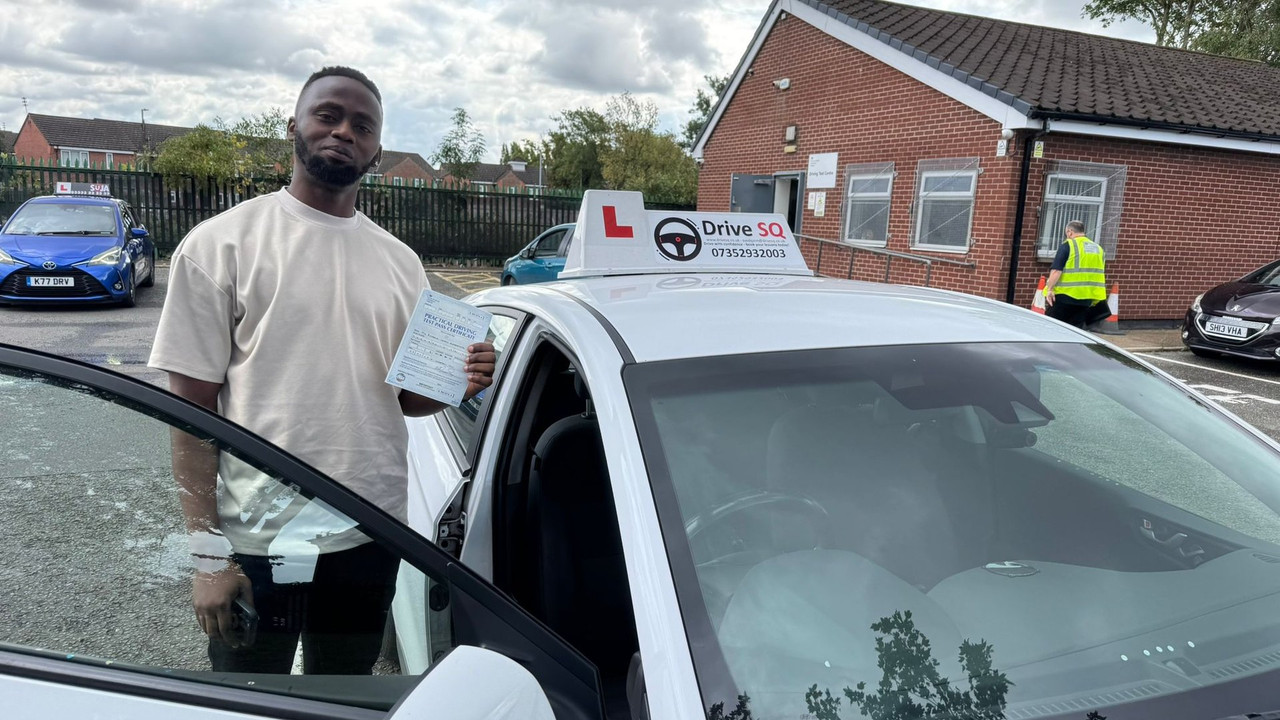
A crash course is the fastest route to your full driving licence. Instead of spreading lessons over months, you take concentrated, back-to-back sessions over a short period — typically 1 to 5 days or 1 to 2 weeks — so that everything stays fresh in your mind.
Unlike traditional weekly lessons where you forget half of what you learned between sessions, a crash course builds momentum. You practise daily, your muscle memory develops quickly, and you reach test standard far sooner.
While both terms are used interchangeably, a crash course usually refers to the most compressed option — 4 to 6 hours per day over a very short timeframe. A standard intensive driving course might spread the same hours over 3 to 4 weeks. At DriveSQ, we offer both and tailor the schedule around you.
Go from beginner to test-ready in as little as one week with daily structured sessions.
Choose from 1-day refreshers to full 2-week courses depending on your experience level.
You stay with one dedicated DVSA approved instructor throughout your entire crash course.
We help book your practical test and prepare you specifically for Manchester test routes.
Crash courses aren't just for beginners. They're perfect for anyone who needs their licence on a tight deadline.
Make the most of your holiday break. Many of our students use their summer or Christmas holidays to complete a crash course and head back to uni with a full licence.
Got a job offer that requires a driving licence? Our crash course gets you road-legal before your start date. We've helped delivery drivers, carers, and sales reps pass in record time.
Failed your test before? A crash course is the perfect way to address weak areas intensively and rebuild your confidence before rebooking.
Already drive abroad? Our short crash courses help you adapt to UK roads and left-hand driving so you can convert to a UK licence quickly.
Spreading lessons over months can make anxiety worse. Daily practice with a patient, encouraging instructor builds real confidence fast. We also offer lessons in Urdu and Punjabi.
Can't commit to weekly lessons for 6 months? Take time off work for a week or two and get it done. We pick you up and drop you off at your door.
Every day of your crash course is carefully structured to maximise learning while keeping you fresh and focused. Here's what a typical day looks like.
Start with new skills and techniques while your concentration is at its peak. Your instructor introduces manoeuvres, junctions, or roundabouts and you practise on quieter roads first before moving to busier routes.
A proper rest is essential. We drop you home or to a nearby cafe. This downtime lets your brain process what you've learned and you return refreshed for the afternoon.
Time to consolidate. You revisit the morning's skills with added complexity — heavier traffic, dual carriageways, independent driving. By the end of day, those new skills feel natural.
Your instructor gives honest, constructive feedback on your progress. You'll know exactly where you stand and what tomorrow's focus will be. No guesswork, no surprises.
All packages are available in both manual and automatic at the same price. No hidden fees, no surprises. Just honest, affordable driving tuition.
Refresher Crash Course
£330
Full Crash Course
£990
Extended Crash Course
£1,320
All prices based on £33/hr. Custom packages available — view full pricing guide.
We've helped hundreds of Manchester learners pass their test quickly. Here's why our crash courses deliver results.
Every single DriveSQ instructor is fully DVSA approved and qualified. No trainee instructors, no part-timers. You get professional, experienced tuition from day one.
Our track record speaks for itself. With a 4.9-star average rating across 87 verified reviews, DriveSQ is one of the highest-rated driving schools in Greater Manchester.
The national average pass rate is around 47%. Our crash course students achieve over 90% first-time passes because we don't send you for the test until you're genuinely ready.
Language shouldn't be a barrier to learning to drive. Our multilingual instructors teach in Urdu and Punjabi, making complex concepts clearer and the experience more comfortable.
All crash course students get free access to our student learning app. Practice theory questions, review road signs, and track your progress between lessons.
We cover every corner of Greater Manchester: postcodes M1–M50, SK1–SK16, BL, OL, and WN. Free pick-up and drop-off from your home, workplace, or university.
Don't just take our word for it. Here's what real DriveSQ crash course students have to say about their experience.
"I booked a 2-week crash course with DriveSQ because I needed my licence before starting a new job. Passed first time with only 3 minors! My instructor was incredibly patient and made the whole experience stress-free."
Amina K. — Didsbury, M20
"After failing twice with another school, I did a 10-hour refresher crash course. The difference in teaching quality was night and day. Passed on my third attempt with zero minors. Wish I'd come here first!"
Rizwan M. — Longsight, M13
"I was so nervous about learning to drive at 34. Having a Punjabi-speaking instructor made everything so much easier. Completed my crash course in 12 days and passed first time. Absolutely recommend DriveSQ!"
Sobia N. — Stockport, SK3
No matter where you are in Greater Manchester, a DriveSQ crash course instructor is nearby. We offer free pick-up and drop-off from your home, workplace, or university — every single day of your course.
Our instructors know every test centre in the region and tailor your crash course to include the specific routes and junctions you'll face on test day.
Everything you need to know about DriveSQ's crash course driving lessons in Manchester.
Your driving licence is closer than you think. Message us on WhatsApp right now and we'll have your crash course planned within the hour. Available 7 days a week.
Typical response time: under 5 minutes • Available 7 days a week
Lessons around Pendleton use real local roads including Eccles Old Road, Broughton Road and Amersham Street, so by the time you're ready for your test you've already driven the streets you'll use every day after passing. Buile Hill Park, Salford's second-oldest park covering 86 acres, was regularly visited by painter L.S. Lowry before he became famous, and its Grade II listed mansion is rumoured to have inspired Frances Hodgson Burnett while writing The Secret Garden.
We also plan around school-run traffic near Light Oaks Junior School and Light Oaks Infant School, using quieter spots like Buile Hill Park for early manoeuvre practice before stepping up to busier sections of Eccles Old Road.
Test centre: most learners around Pendleton test at Salford (Fire Station) Driving Test Centre, Liverpool Street, Ordsall, Salford, M5 4LE; mock tests are planned around the routes examiners actually use from there.
“Honest feedback every lesson, and routes that actually matched what came up on test day near Salford (Fire Station) Driving Test Centre, Liverpool Street, Ordsall, Salford, M5 4LE.” – Tom, Pendleton
Building local road knowledge is one of the most underestimated aspects of driver training. Knowing which junctions require extra observation, where speed limits change, and where vulnerable road users are most likely to appear turns a competent learner into a genuinely safe driver for life. DriveSQ lessons are planned around the actual roads you will drive every day after passing.
Stopping distances: The Highway Code stopping distances — based on a 13.5-metre car in dry conditions — are the minimum legal reference points. In wet conditions, stopping distances at least double. In icy conditions, stopping distances can be ten times greater than dry distances. At 70mph on ice, a car travelling with 13.5 metres of following distance needs 750 metres to stop safely — over half a mile. These figures make a compelling case for reduced speed in adverse conditions.
DriveSQ instructors bring nationally-accredited teaching methodology to every lesson, combined with deep local knowledge of Greater Manchester roads. Every lesson is planned to build on the previous one, creating a progressive learning journey from first drive to test-ready confidence.
Greater Manchester's road network covers over 4,500 miles of road managed across ten metropolitan boroughs. The network includes motorways (M60, M62, M56, M61, M63), A-roads of regional importance (A6, A34, A56, A57, A580), and an extensive local road grid of B-roads and unclassified roads. Understanding the network hierarchy — and the different driving demands at each level — is a key part of driver education.
Manchester's city centre road network is managed by TfGM (Transport for Greater Manchester) using a SCOOT adaptive traffic signal system that responds to real-time vehicle detector data. This means signal phases can be shorter or longer than expected — learners should always approach signals prepared to stop rather than accelerating in anticipation of a green phase.
The hazard perception test requires candidates to identify developing hazards — situations that would cause a driver to take action, such as slowing, stopping, swerving or changing position. The test uses 14 video clips, each approximately one minute long, filmed from a driver's perspective in real traffic. One clip contains two developing hazards rather than one — this clip is not identified in advance. Scoring is based on response time: a response within the first second of hazard development scores five points, falling to four, three, two or one point as response time increases, with zero points for responses outside the scoring window. A score of at least 44 out of 75 is required to pass. Research has shown that real-world driving experience before the hazard perception test significantly improves scores — even non-driving passengers who focus on hazard identification during car journeys develop faster response patterns. Clicking rapidly and repeatedly (clutching) to beat the system triggers a fraud detection algorithm that eliminates the score for that clip entirely — a deliberate trap built into the test software.
Driver fault accumulation is not linear in its impact on test result. A candidate with 14 driver faults (one below the fail threshold) passes with the same result as a candidate with zero driver faults. However, the driver faults recorded provide useful feedback — any category with three or more driver faults recorded by the examiner is typically highlighted for post-test improvement even when the test is passed.
The green novice driver plate (displayed voluntarily by new drivers) has no legal status in England, Scotland and Wales but is widely respected by other drivers. Northern Ireland requires new drivers to display R plates for two years after passing. The DVSA recommends new drivers consider using N-plates or green P-plates for at least three months to encourage following drivers to give additional space and patience. The plate also serves as a self-reminder — research shows drivers who display a novice plate in the first months after passing drive more carefully and have fewer incidents.