Understanding Your Test Report
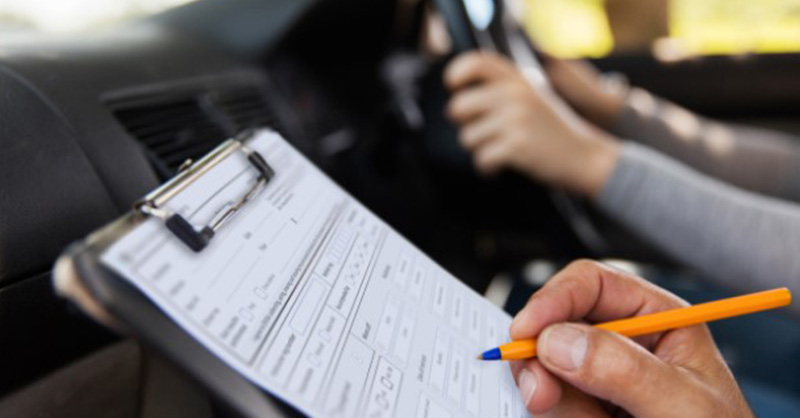
Your test report contains fault markings across 31 competency categories. Each marking represents a specific moment where the examiner observed a deviation from the required standard. A serious fault indicates genuine danger; a driving fault represents less-than-ideal execution. Three driving faults in the same category escalate to a serious fault.
DriveSQ instructors interpret your report with examiner-level precision, identifying not just what went wrong but why — distinguishing knowledge gaps, observation habits, timing errors, and anxiety-driven performance failures.
Common Serious Faults on Manchester Tests
Junction Observations
The most frequent serious fault across Manchester test centres. Candidates approach T-junctions or roundabouts without adequate observation of approaching traffic, often due to anxiety-driven rushing. The fix: stop, look right, look left, look right again, assess, proceed only when genuinely safe.
Positioning Errors
Incorrect lane discipline on multi-lane roundabouts, straddling lane markings on dual carriageways. These typically stem from uncertainty about road layout rather than vehicle control deficiency. Route familiarity training eliminates most positioning faults.
Mirror Neglect
Failing to check mirrors before signalling, changing speed, or altering course. Often reflects automated behaviour from private practice where mirror checks were not enforced. Rebuilding mirror-signal-manoeuvre as an unbreakable habit requires deliberate repetitive practice.
Road Marking Responses
Proceeding past stop lines without fully stopping, entering yellow box junctions without a clear exit. Usually indicates visual processing overload rather than rule ignorance.
DriveSQ's Retest Recovery Programme
Session One: Diagnostic Debrief
No driving. We analyse your report marking by marking, reconstructing exact scenarios. Your instructor asks what you remember — what you saw, decided, did. This reveals whether faults stemmed from knowledge gaps, observation deficiencies, or anxiety-driven errors.
Sessions Two to Four: Targeted Remediation
Each session focuses exclusively on your fault categories. If junctions were your weakness, we visit every junction type within two miles of your test centre until correct procedure becomes genuinely automatic.
Sessions Five to Six: Mock Tests
Complete DVSA-format mock tests scored against official criteria. Your instructor adopts examiner behaviour: minimal conversation, standardised directions, formal manoeuvre requests. This habituates your nervous system to assessment conditions.
Session Seven: Test-Day Preparation
Light driving on familiar routes to confirm sharp skills, followed by a confidence-building debrief reminding you of documented progress since your last attempt.
"Failed my first test at West Didsbury with three serious faults. My DriveSQ instructor rebuilt my junction observations from scratch and ran four mock tests. Passed with just two minors. The failure genuinely made me a better driver."
— Callum, M14, passed February 2026