★★★★★
Sarah M.
Didsbury, M20
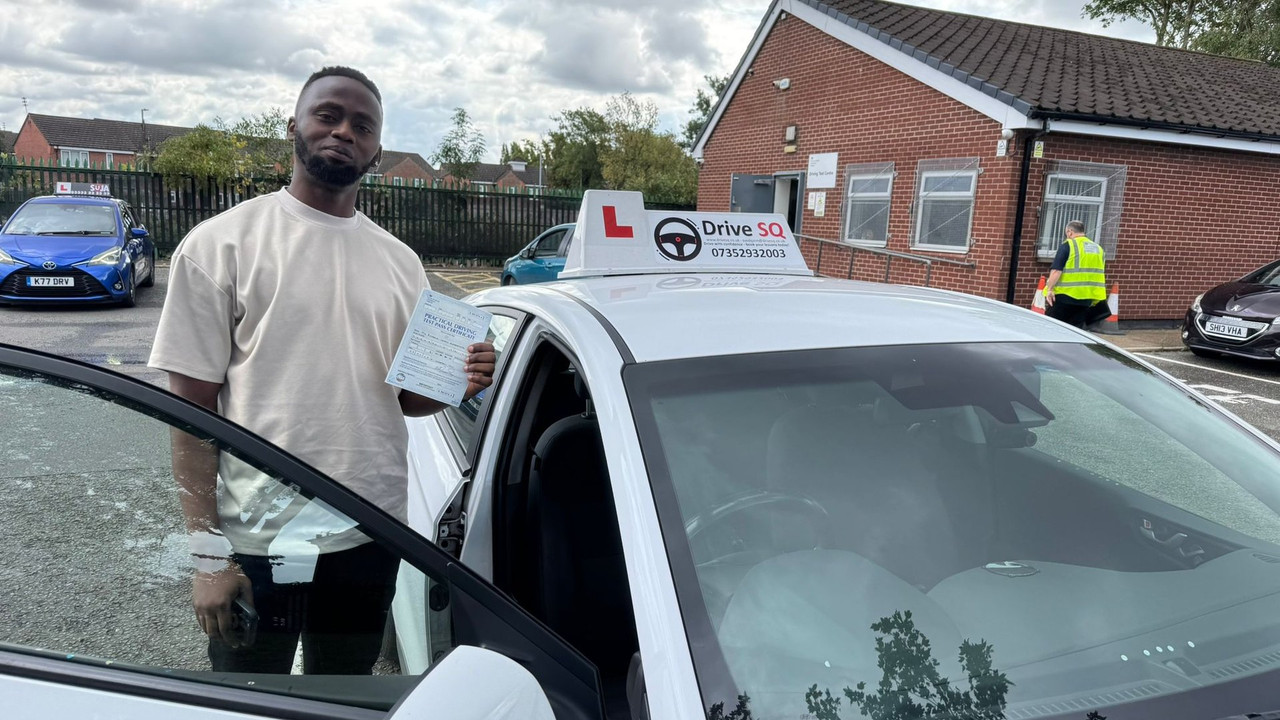
"Passed first time with DriveSQ! Same price for automatic was a massive bonus. Patient, calm instructor who knew every test route."
Verified Google Review
Compare driving lesson prices across Manchester driving schools. DriveSQ offers £35/hr manual and automatic — see how we compare on price, pass rate, and value for money.
Price matters — but the cheapest hourly rate does not always mean the cheapest route to a licence. Here is how DriveSQ’s pricing stacks up against the Manchester market, and why total cost matters more than hourly rate.
Driving lesson prices in Manchester vary significantly:
What truly matters is the total cost to pass. Consider two scenarios:
School A: £35/hr, 45 hours needed (50% pass rate) = £1,260 + potential resit costs
DriveSQ: £35/hr, 32 hours needed (90%+ pass rate) = £1,056
The “cheaper” school costs £200+ more in total — plus the time and stress of additional lessons and potential test failures.
If you are learning automatic, DriveSQ saves you even more. Most Manchester schools charge £36–£42/hr for automatic lessons. At DriveSQ, automatic is the same £35/hr as manual. Over 30 lessons, that’s a saving of £90–£270 compared to typical automatic premiums.
£35/hr for DVSA-approved instructors with a 90%+ pass rate. Mid-range price, premium results. Manual and automatic same price — always.
Test-day car fees, fuel surcharges, weekend premiums, admin charges, trainee instructors. DriveSQ has none of these — £35/hr covers everything.
Can’t find your answer? WhatsApp us instantly
Manual & automatic always the same price. No hidden extras.
Over 1,000 Manchester learners passed with DriveSQ
"Passed first time with DriveSQ! Same price for automatic was a massive bonus. Patient, calm instructor who knew every test route."
"Best driving lessons in Manchester. My instructor knew every route from Sale test centre. Passed within 3 months from complete beginner."
"Very nervous starting lessons — DriveSQ made me feel at ease from day one. Claimed the M19 £330 offer too. Passed first time."
Join 1,000+ Manchester learners who passed with DriveSQ. WhatsApp us now for the fastest reply.
WhatsApp 07352 932003Lessons around Chorlton-cum-Hardy use real local roads including Beech Road, Wilbraham Road and Barlow Moor Road, so by the time you're ready for your test you've already driven the streets you'll use every day after passing. Bull-baiting was still taking place on Chorlton Green as late as 1835, long after the practice had died out in most of the rest of the country.
We also plan around school-run traffic near Chorlton High School and St Joseph's RC Primary School, using quieter spots like Chorlton Green for early manoeuvre practice before stepping up to busier sections of Beech Road.
Test centre: most learners around Chorlton-cum-Hardy test at West Didsbury Driving Test Centre, Unit 11 Christie Park, West Didsbury, M21 7QY; mock tests are planned around the routes examiners actually use from there.
“Recommend to anyone learning around Chorlton-cum-Hardy — real local roads, real local knowledge, none of the guesswork.” – Ruby, Chorlton-cum-Hardy
Fill in your details and we'll be in touch within 2 hours.
Building local road knowledge is one of the most underestimated aspects of driver training. Knowing which junctions require extra observation, where speed limits change, and where vulnerable road users are most likely to appear turns a competent learner into a genuinely safe driver for life. DriveSQ lessons are planned around the actual roads you will drive every day after passing.
Highway Code update 2022: The Highway Code was substantially updated in January 2022 with a new hierarchy of road users placing pedestrians at the top and motorists at the bottom. Key changes include: pedestrians have priority at junctions when drivers are turning; cyclists may use the centre of a lane; and 'Dutch reach' door-opening technique is now recommended. All DriveSQ learners are taught the updated 2022 rules.
DriveSQ instructors bring nationally-accredited teaching methodology to every lesson, combined with deep local knowledge of Greater Manchester roads. Every lesson is planned to build on the previous one, creating a progressive learning journey from first drive to test-ready confidence.
Greater Manchester's road network covers over 4,500 miles of road managed across ten metropolitan boroughs. The network includes motorways (M60, M62, M56, M61, M63), A-roads of regional importance (A6, A34, A56, A57, A580), and an extensive local road grid of B-roads and unclassified roads. Understanding the network hierarchy — and the different driving demands at each level — is a key part of driver education.
Manchester's city centre road network is managed by TfGM (Transport for Greater Manchester) using a SCOOT adaptive traffic signal system that responds to real-time vehicle detector data. This means signal phases can be shorter or longer than expected — learners should always approach signals prepared to stop rather than accelerating in anticipation of a green phase.
Motorway signs use a specific design language distinct from all-purpose road signs. Blue rectangular signs indicate destinations and distances. Orange and yellow signs indicate roadworks. Matrix signs on overhead gantries display variable messages — mandatory speed limits in a red circle, lane closure X-signs in red, advisory messages in amber text. A mandatory signal on a motorway gantry must be obeyed exactly as a permanent roadside sign — the only exception is if compliance would require an emergency manoeuvre. Variable speed limits on smart motorways are enforced at the gantry where they are displayed, not just at the camera housings — some sections have gantry cameras every 500 metres. LED signals on overhead gantries have a visible range of approximately 400 metres in good visibility — approaching at 70mph, a driver has approximately 20 seconds to respond to a new signal, highlighting the importance of constant forward scanning. Flashing amber lights alongside a red X sign on an adjacent lane mean 'this lane is closed ahead — move out safely as soon as possible'. A solid red X means the lane is closed immediately — no vehicle may enter or remain in a lane marked with a red X.
Test cancellation by the candidate requires at least three clear working days' notice to avoid forfeiture of the £62 test fee. If the DVSA cancels a test due to examiner sickness or other operational reasons, a full refund is offered. The waiting time for a test appointment varies significantly by test centre — Manchester centres typically have 4-10 week waits in normal periods, but backlogs following industrial action or pandemic disruptions can extend this to 16+ weeks.
UK driving licence endorsements (penalty points) accumulate on your licence and are visible to insurers. For newly qualified drivers (within two years of passing their first test), the threshold for licence revocation is 6 points — compared to 12 points for experienced drivers. This 'new drivers' rule means that a single speeding offence (typically 3 points) combined with a mobile phone offence (6 points) would immediately revoke a new driver's licence, requiring them to pass both theory and practical tests again from scratch. Understanding this consequence makes point-free driving in the first two years a financial and practical imperative.