Understanding Roundabout Anxiety
Fear of roundabouts is extraordinarily common. In DriveSQ surveys, 68% of learners identify roundabouts as their number-one source of driving anxiety. The reason is straightforward: roundabouts compress multiple complex decisions into a few seconds. You must simultaneously assess approaching traffic, choose the correct lane, regulate your speed, signal appropriately, and steer through a curved path — all while other road users close in around you.
Traditional instruction handles this by throwing learners at roundabouts repeatedly and hoping familiarity reduces the fear. It often does not. DriveSQ takes a fundamentally different approach: we decompose the roundabout into its individual components, teach each one in isolation, then reassemble them gradually. The result is genuine competence — not just desensitised tolerance.
The DriveSQ 5-Stage Roundabout Programme
Stage 1: Theory and Observation
Before approaching any roundabout, your DriveSQ instructor parks near one and explains the traffic flow. You watch vehicles entering, circulating, and exiting. You count exits. You identify which lane each driver uses. This observation phase removes the mystery — you understand the system before you participate in it.
Stage 2: Mini-Roundabouts
Mini-roundabouts in quiet residential areas (Heaton Park, Gorton, Worsley) have low traffic volumes and slow speeds. They require the same decision-making process as large roundabouts but in a forgiving environment. DriveSQ uses mini-roundabouts to embed the mirror-signal-position-speed-look routine until it becomes automatic.
Stage 3: Standard Single-Lane Roundabouts
Once mini-roundabouts feel comfortable, we progress to standard roundabouts with moderate traffic — Palatine Road in Didsbury, Sale area roundabouts, Prestwich residential roundabouts. These introduce faster-moving traffic and slightly larger turning circles, but the fundamental procedure remains identical to what you practised on mini-roundabouts.
Stage 4: Multi-Lane Roundabouts
Manchester's larger roundabouts — Chorlton (Barlow Moor Road), Princess Parkway, Crown Point (M60), Trafford Centre — require lane discipline. DriveSQ teaches the "clock face" method for lane selection and practises each large roundabout from every entry direction. By this stage, your foundation skills are so strong that lane selection is the only new variable.
Stage 5: Test-Route Roundabouts
Every Manchester test centre has 2-3 roundabouts that appear on the majority of test routes. DriveSQ drills these specific roundabouts until they feel as routine as driving in a straight line. By test day, the examiner's instruction to "take the second exit at the roundabout" triggers a calm, automatic response rather than a surge of panic.
"Roundabouts made me physically sick with anxiety before DriveSQ. The five-stage approach was a revelation — by stage three I actually started enjoying them. Sounds impossible, but it happened."
— Leah, Stretford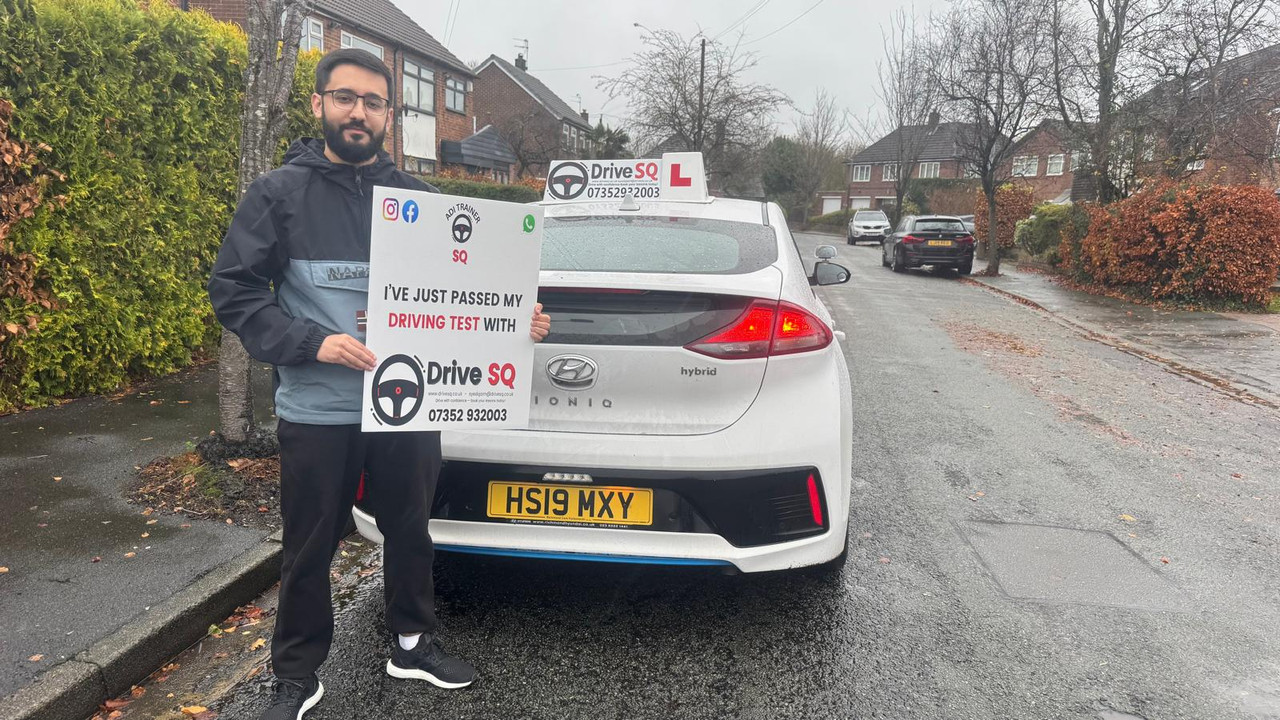
Manchester's Roundabout Types Explained
Mini-Roundabouts
White painted circle on the road. Low speed, small radius. Found in residential areas across M8, M9, M18, M19. Give way to traffic from the right but the pace is gentle.
Standard Roundabouts
Physical island with road markings. One or two lanes. Found on B-roads throughout Manchester. Moderate traffic speed. The most common type on test routes.
Multi-Lane Roundabouts
Two or three approach lanes, overhead gantry signs. Found on A-roads and near motorway junctions. Require confident lane selection well before the roundabout.
Spiral Roundabouts
Lane markings spiral outward, guiding you to the correct exit lane automatically. Follow the painted lines precisely. Less intimidating than they appear once you trust the markings.
DriveSQ Roundabout Confidence Package
- £35/hr — all lessons include roundabout practice
- 10-hour block: £330 — save £20
- Dedicated roundabout sessions available on request
- PassFirst guarantee — free extra lessons if needed
- Same patient instructor throughout
Watch DriveSQ navigate Manchester roundabouts with a nervous learner — calm, structured, supportive.