Before Your Lesson Arrives
Your first lesson begins before your instructor arrives. The physical preparation — appropriate footwear, comfortable clothing, provisional licence in your pocket — removes practical anxiety so your mental energy is available for the driving itself.
Wear flat, thin-soled shoes that allow you to feel the pedals. Running trainers are ideal; boots, heels, and thick-soled shoes reduce the sensitivity essential for smooth clutch control. Choose clothing that allows unrestricted leg movement — you will be operating three pedals with your feet and steering with your arms simultaneously.
Eat a light meal 60-90 minutes before your lesson. Low blood sugar impairs concentration and increases anxiety. Avoid excessive caffeine, which amplifies nervousness. Bring a water bottle — dehydration causes fatigue that mimics anxiety symptoms.
The First 15 Minutes
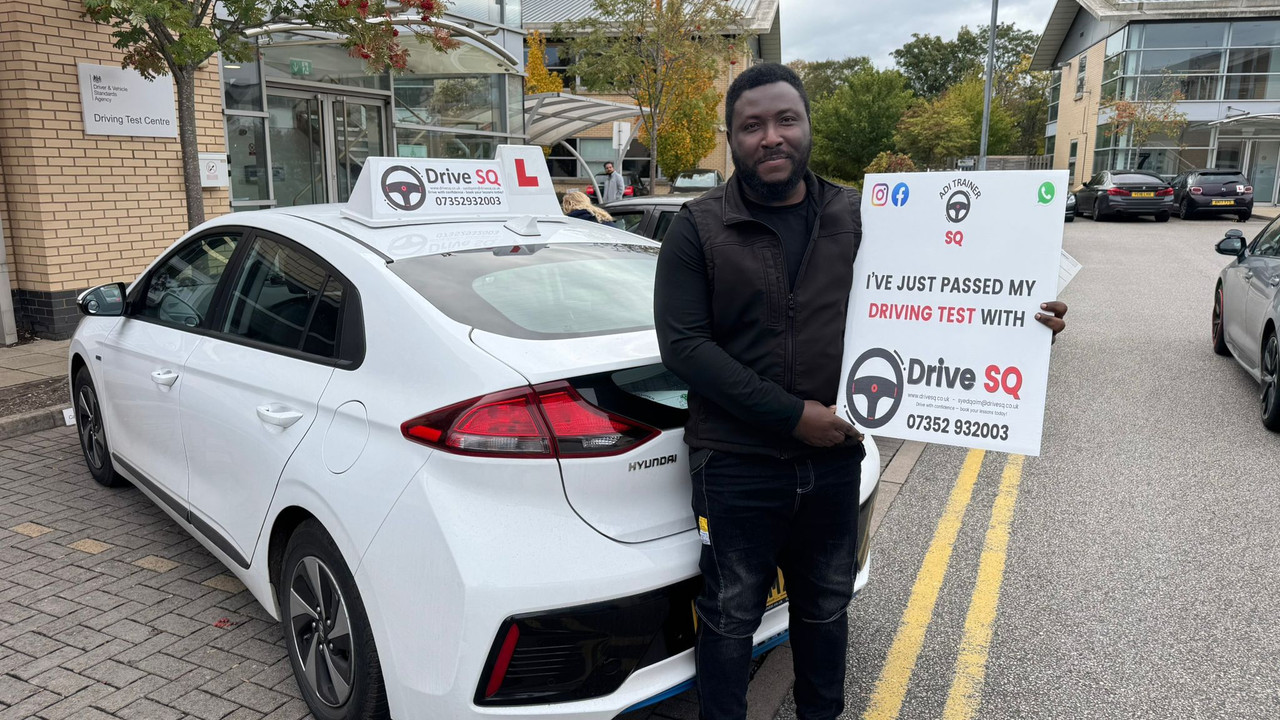
Your instructor arrives in a clearly marked dual-control vehicle. Before any driving begins, you will spend time on the cockpit drill — a systematic introduction to every control you will use. This stationary familiarisation is not wasted time; it is the foundation that prevents confusion once the vehicle is moving.
Cockpit Drill
Doors locked, seat adjusted for reach and visibility, mirrors positioned for your eye height, seatbelt secured, handbrake checked. Your instructor explains each adjustment's purpose and demonstrates the correct positions. This routine becomes second nature by lesson three.
Pedal Introduction
Three pedals from left to right: clutch, brake, accelerator. Your instructor explains each pedal's function and demonstrates how they feel underfoot. You practise pressing and releasing each one while stationary, building the foot memory that smooth driving requires.
Steering Basics
Hand position at ten-and-two or quarter-to-three. Push-pull steering technique for turns. Your instructor demonstrates, then you practise turning the wheel while stationary. This seemingly simple skill prevents the crossed-arm steering that causes loss of control in turns.
Gear Familiarisation
The gear lever pattern — reverse, first through fifth, neutral. Your instructor guides your hand through each gear position with the clutch fully depressed. Understanding the gate pattern while stationary prevents the frustrating gear-hunting that occurs if this step is rushed.
Your First Moving Experience
Moving off for the first time is simultaneously the most anticipated and most feared moment. Your instructor guides you through the sequence: clutch down, select first gear, set the gas slightly, find the biting point, release the handbrake, gently raise the clutch. The car begins to move — and you are driving.
The sensation is universally surprising. New drivers expect driving to feel dramatic; in reality, a well-controlled first gear crawl feels gentle and manageable. This positive first experience is psychologically important — it replaces imagined difficulty with experienced simplicity.
Your instructor's dual controls provide a genuine safety net. If you apply too much acceleration, your instructor can brake. If you freeze, your instructor can steer. This safety net is not theoretical — it is a physical system that eliminates the possibility of dangerous outcomes during your first lesson.
What You Will Cover
A typical first lesson covers: moving off and stopping, basic steering on a straight road, gentle left turns, mirror checking, understanding stopping distance at low speed, and — for confident beginners — a T-junction approach. The amount covered depends entirely on your individual pace.
After Your First Lesson
Immediately after your lesson, spend five minutes noting what you learned, what felt comfortable, and what felt challenging. This reflection consolidates the session's learning and provides your instructor with useful feedback for planning lesson two.
Expect to feel mentally tired — driving engages your brain at a level comparable to learning a musical instrument. This fatigue is normal and indicates genuine cognitive processing. Rest well, and your brain will consolidate the day's motor learning overnight.
"I was absolutely terrified before my first lesson — my hands were shaking when the instructor arrived. Within fifteen minutes I was driving down a quiet road and actually smiling. DriveSQ made the impossible feel completely manageable."
— Sophie, M20, first lesson October 2025