Everything Manchester learners need to know about driving insurance — what your driving school covers, when you need your own policy, types of learner cover, estimated costs, and how to save on your first car insurance after passing.
This is the number one question Manchester learners ask — and the short answer is no, not for your driving lessons. When you learn with a professional driving school like DriveSQ, you are fully covered under the instructor’s comprehensive insurance policy. This cover applies from the moment you get into the lesson car until you step out. You do not need to arrange, pay for, or even think about insurance for your professional lessons.
DriveSQ’s insurance covers you across every Manchester postcode we operate in — from M1 to M45, SK, BL, OL, and WN areas. Whether you are driving through Didsbury, navigating Stockport Road, or practising roundabouts in Sale, you are fully insured at all times during your lesson.
However, there is one situation where you do need your own learner driver insurance: private practice. If you want to practise driving between lessons in a family member’s or friend’s car, you must be properly insured on that vehicle. Driving without valid insurance is a criminal offence that carries 6–8 penalty points, an unlimited fine, and potential vehicle seizure — even on a provisional licence.
Research from the DVSA shows that learners who combine professional lessons with regular private practice typically need fewer paid lessons to reach test standard. For a Manchester learner taking weekly lessons with DriveSQ, adding 2–3 hours of supervised private practice per week can accelerate progress significantly. This is where learner driver insurance becomes relevant.
The key rule for private practice is simple: you must have a qualified supervising driver in the passenger seat at all times. This person must be aged 21 or over and have held a full UK driving licence for at least 3 years. They must not be under the influence of alcohol or drugs. The car must display L-plates (or D-plates in Wales) on the front and rear.
Every DriveSQ lesson is fully insured. Our comprehensive instructor policy covers you from start to finish — no extra cost, no paperwork, no excess. Just focus on learning to drive.
Learners who do 2–3 hours of private practice per week alongside professional lessons often reach test standard 20–30% faster. Just make sure you have valid insurance on the practice car.
Driving without insurance — even as a learner — carries 6–8 penalty points, an unlimited fine, and vehicle seizure. Always check you are covered before practising privately.
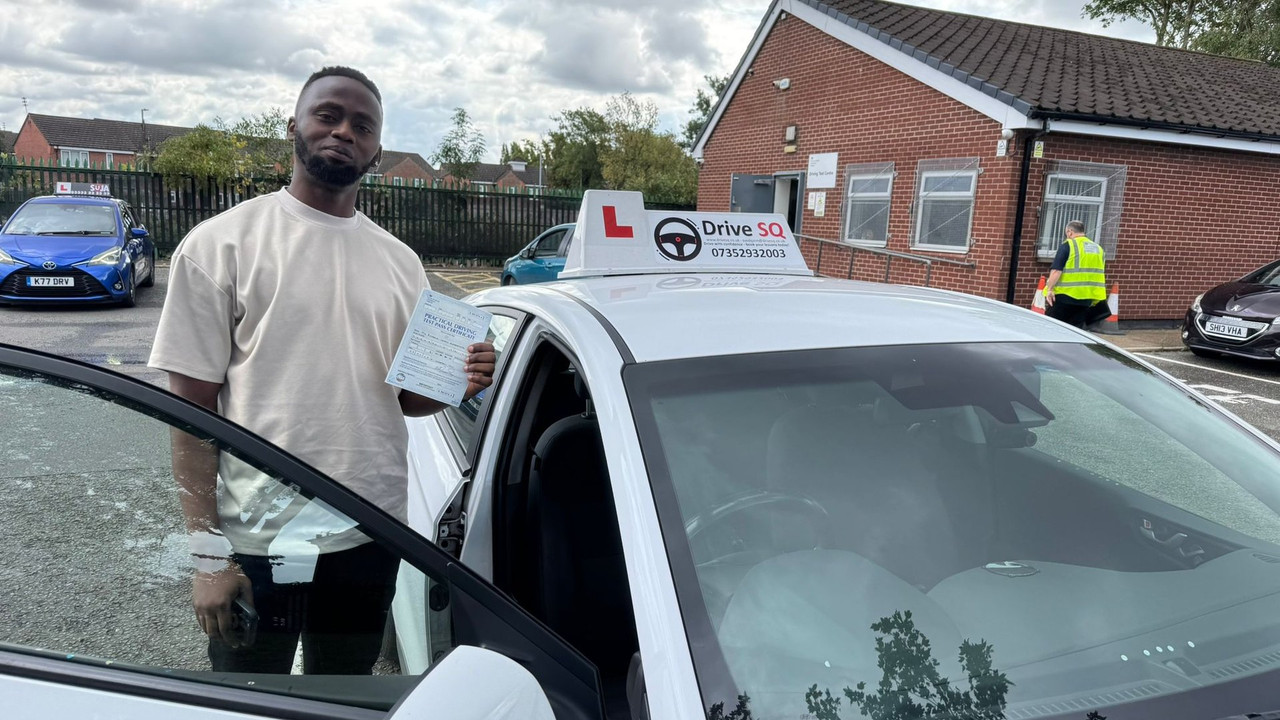
If you want to practise in a family or friend’s car between lessons, here is what you need to know.
Getting insured to practise privately is straightforward, but you need to choose the right type of cover for your situation. The wrong choice can cost you hundreds of pounds unnecessarily, or worse, leave you uninsured without realising it.
There are three main routes to getting insured for private practice as a learner driver in Manchester. Each has different costs, benefits, and drawbacks depending on how often you plan to practise, whose car you will use, and how long until your driving test.
Before choosing a policy, consider these factors: How often will you practise? If it is once a week, pay-per-hour may be cheapest. If it is 3–4 times per week, an annual policy makes more sense. Whose car will you use? Being added to a parent’s policy is often the simplest route. How long until your test? If you are test-ready within a month, a short-term policy avoids paying for cover you will not use.
Three main options — each suited to different situations and budgets.
Learner driver insurance costs in Manchester vary significantly based on your age, postcode, the car you are practising in, and the type of cover you choose. As a general guide, expect to pay between £100 and £200 per month for an annual learner policy in Manchester.
Younger learners (17–19) typically pay at the higher end of this range, while those aged 25+ often get cheaper quotes. The car’s insurance group matters enormously — practising in a parent’s small hatchback (group 1–5) will be far cheaper than a larger family car (group 15+).
Always compare quotes from multiple providers. Specialists like Collingwood, Marmalade, and Adrian Flux focus specifically on learner and young driver insurance, often beating mainstream insurers on price. Use comparison sites but also check specialist providers directly — they sometimes offer exclusive deals not listed on aggregators.
Remember that the cheapest quote is not always the best value. Check the excess amount (the portion you pay in a claim), what the policy covers (fully comprehensive vs third-party only), and whether it builds a no-claims bonus. A slightly more expensive policy that builds no-claims can save you thousands over the first few years of driving.
Choose a car in insurance group 1–10 for private practice. A Ford Fiesta (group 3) or Vauxhall Corsa (group 2) will be dramatically cheaper to insure than a Golf GTI (group 29). The practice car does not need to match your lesson car.
Practising 2hrs/week for 6 months:
Pay-per-hour (at £5/hr): ~£260
Annual policy (at £150/mo): ~£900
Named driver addition: ~£100
For occasional practice, pay-per-hour wins. For daily practice, annual policies are better value.
Remember — all these costs are for private practice only. Your DriveSQ driving lessons are always fully insured at no extra cost. £33/hr is all you pay.
Smart moves now can save you hundreds — even thousands — on your first year of driving.
Where you live in Manchester has a significant impact on your insurance premium — both as a learner and after you pass. Insurers use postcode data to assess the risk of theft, vandalism, and accidents in your area, and Manchester postcodes vary enormously in their risk ratings.
Inner-city postcodes like M14 (Moss Side, Fallowfield, Rusholme), M8 (Cheetham Hill, Crumpsall), M11 (Beswick, Clayton), and M40 (Moston, Collyhurst) are rated as higher risk by insurers. Premiums in these areas can be 20–40% higher than the Manchester average. This is driven by higher rates of vehicle theft, uninsured drivers, and accident claims in these postcodes.
Suburban postcodes like M20 (Didsbury), M33 (Sale), M21 (Chorlton), SK8 (Cheadle), and M31 (Urmston) attract lower premiums. These areas have lower crime rates, more off-street parking, and fewer insurance claims per capita. A learner in M20 could pay 25–35% less than a learner in M14 for identical cover on the same car.
You cannot change your postcode, but you can influence other factors. Park off-street where possible. Choose a low-group car. Add security features (steering lock, tracker). Avoid modifications. And most importantly, learn to drive properly — a clean record from day one is your best long-term insurance strategy.
If you live in a higher-risk postcode, consider that the total cost of learning to drive includes both lesson fees and insurance. DriveSQ’s £33/hr rate and 90%+ pass rate mean you reach test standard faster, spending less time (and money) on the road as a higher-premium learner. Every lesson saved is money saved on insurance too.
Higher premium areas:
M14 (Moss Side/Fallowfield) — High
M8 (Cheetham Hill) — High
M11 (Beswick/Clayton) — High
M40 (Moston/Collyhurst) — High
Lower premium areas:
M20 (Didsbury) — Low
M33 (Sale) — Low
M21 (Chorlton) — Low-Medium
SK8 (Cheadle) — Low
M31 (Urmston) — Low
The faster you pass your test, the sooner you stop paying learner insurance premiums. DriveSQ’s 90%+ first-time pass rate means most learners are test-ready in fewer lessons — saving you weeks or months of insurance costs.
Manual & automatic always the same price. No hidden extras. Full insurance included.
Join 1,000+ Manchester learners who passed with DriveSQ. Fully insured lessons from £33/hr — WhatsApp us now.
WhatsApp 07352 932003