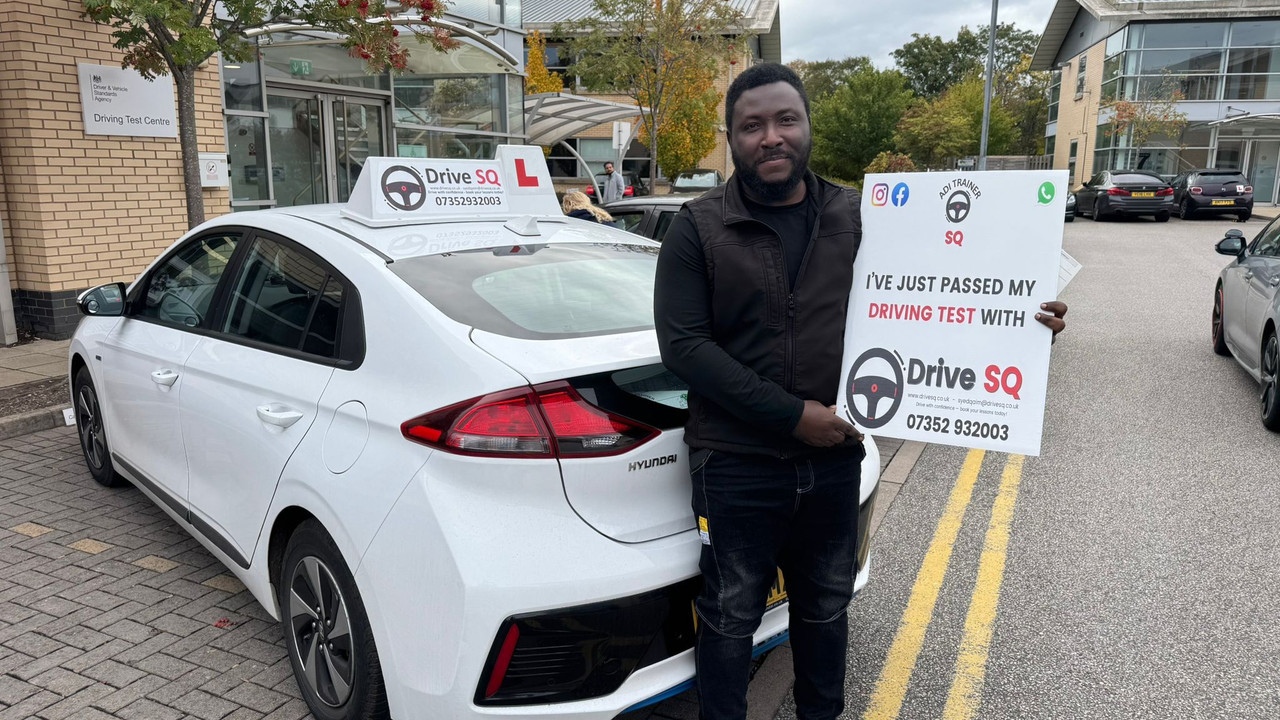
Driving Lessons in Bredbury, Stockport
DriveSQ covers every street in Bredbury (SK6) — every lesson uses the real local roads you'll face on your driving test.
Book a Lesson
Fill in your details and we'll be in touch within 2 hours.
- Your request goes straight to the DriveSQ team (it isn't sold or shared).
- We call or text you to match you with an instructor near your postcode.
- You pick a time. You get free access to the DriveSQ Student Portal to track progress and revise.
No payment is taken through this form. By sending it you agree we can contact you about your lessons. Privacy
Why Learn to Drive in Bredbury?
Bredbury is a varied training environment. Your instructor will start on quieter streets to build core skills — clutch control, mirror routines, smooth stopping — before progressing to the busier roads that appear on Bredbury examiner routes.
Every lesson is structured around a clear objective, so by the end you'll always know exactly what improved and what to practise next. There's no filler — just targeted, practical driving that adds up.
Key Roads We Use in Bredbury
- Lingard Lane
- Ashton Road
- Stockport Road
- George Lane
What Bredbury Learners Find Challenging
Knowing where the difficulty lies means you prepare for it — not meet it for the first time on test day. In Bredbury, learners typically find George Lane hill start — the steepest hill on the Bredbury test route the most demanding sections. We address these directly in dedicated lesson blocks.
Where Bredbury Learners Build Confidence First
Every learner starts on more forgiving roads. In Bredbury, that means Stockport Road's wider sections south of the test centre — enough space and predictability to cement the basics before stepping up.
Local School: Bredbury St Marks CE Primary School
School zones are some of the most complex hazards learners face. We practise near Bredbury St Marks CE Primary School during off-peak hours first, building awareness of crossing points, lollipop patrols and parent parking patterns — then revisit at busier times as your skill grows.

Preparing for Bredbury Driving Test Centre
The test centre is at 90 Lingard Lane, Bredbury SK6 2QT. From Bredbury, your examiner route will typically cross some of the SK6 roads above before reaching the distinctive Ashton Road roundabout and George Lane hill start. We practise this exact transition multiple times before your test date.
Bredbury's pass rate is approximately 54% — above the national average of 48.7%. Our preparation focuses on the faults that cost learners their tests here: observation at junctions, inappropriate speed, and lane discipline at roundabouts.
"I live near the test centre so I asked DriveSQ to focus our lessons on George Lane and the Ashton Road roundabout. Best decision — I knew every inch of those roads on test day."
"George Lane hill start — I must have done it 30 times before my test. My DriveSQ instructor said that's exactly what it takes. Passed first time."
DriveSQ Student App — Free with Every Course
Our student app gives you everything you need to pass faster:
- 700+ theory practice questions updated to 2025 DVSA standards
- 14 full mock theory tests with timed conditions
- HD hazard perception video clips with scoring
- Progress tracker so you and your instructor see exactly where you are each week
- Direct instructor messaging — ask questions between lessons
- Works offline — no signal needed on revision nights
Lesson Options for Bredbury Learners
- Standard lessons: 60 or 90 minutes, any day including evenings and weekends
- Intensive courses: compress your learning into focused daily sessions
- Refresher sessions: rebuild confidence after a break or failed test
- Mock tests: full 38-minute examiner-style test with written feedback
- Pass Plus: £190 for 6 DVSA modules — motorway, night, rural, dual carriageway
Pricing
- £35/hr — standard Bredbury rate
- 10 hrs for £330 — block booking
- Doorstep pickup in Bredbury — no extra charge
Book a Lesson in Bredbury Today
Call, WhatsApp or book online — we'll confirm your slot same day.
Driving in Stockport — Local Knowledge That Matters
Stockport (SK1) is a hilly market town with complex junctions and busy retail core. Learner drivers in this area build their skills on real local roads including A6 Buxton Road and Mersey Square, with Merseyway Shopping Centre and Stockport Market serving as practical navigation landmarks. Local knowledge is a genuine advantage when preparing for the DVSA practical test from Bredbury Driving Test Centre.
Local road fact: Mersey Square roundabout at the base of the town centre is notorious for its complex lane markings — DVSA test routes regularly include it as an assessment of roundabout planning.
What this means for learners: Understanding local road patterns in Stockport is part of becoming a safe, confident driver. Stockport market, one of England's largest covered markets, creates significant Friday and Saturday pedestrian spillage onto surrounding roads, testing hazard perception in real conditions.
The steep gradient on Chestergate requires accurate hill-start technique and early anticipation on approach — an ideal spot for consolidating clutch control and handbrake starts.
Lessons in Stockport cover the full spectrum of road environments found in SK1: residential side streets for early control practice, arterial roads for speed management and lane discipline, and local junctions that replicate the exact conditions assessed during the DVSA practical test. By the time you pass, every road in Stockport should feel familiar and manageable.
Key Driving Knowledge for Greater Manchester
- Speed limits are maximums, not targets — always drive at the speed appropriate for the road conditions, visibility and traffic density.
- Highway Code Rule 170 requires you to give way to pedestrians when turning into a side road if they are already crossing.
- Roundabout lane selection must be decided before the give-way line — changing lanes inside a roundabout is one of the most common causes of serious test faults.
- Mirror checks should happen every 5-8 seconds on open roads and before every speed change, direction change or manoeuvre.
DVSA statistics: The UK practical driving test pass rate is approximately 48% on first attempt — meaning more than half of all candidates fail at least once. The most common serious fault categories are observation at junctions (31% of all serious faults), use of mirrors (19%) and incorrect response to traffic signs (11%). Structured lesson plans that specifically address these three areas significantly improve first-time pass rates.
DriveSQ instructors covering Stockport bring detailed knowledge of SK1 roads to every lesson. The steep gradient on Chestergate requires accurate hill-start technique and early anticipation on approach — an ideal spot for consolidating clutch control and handbrake starts. This local expertise means your lessons are always targeted, relevant and directly applicable to the roads you will drive every day after passing.
More About Stockport — Driving Context
History: Stockport's name combines 'stoc' (Old English for outlying settlement) with 'port' (market town) — the Roman fort of Mamucium supplied from Stockport's market crossing is recorded as early as the 1st century AD.
Transport links: Stockport railway station, a major interchange on the Manchester to London Midland Main Line, generates significant taxi and drop-off traffic on Wellington Road South — learners navigating this area must manage heavy stopping traffic at the station entrance.
Key road to know: The A6 through Stockport descends steeply from Hazel Grove toward Mersey Square — learners must understand how to use engine braking effectively on this gradient to avoid brake fade and maintain smooth speed management.
Parking in Stockport: Stockport's multi-storey car parks on Grand Central car park and Prince's Street include very tight turning radii on ramps — learners benefit from practising multi-storey manoeuvres as part of their post-test confidence building.
Weather and road conditions: Stockport's position in the Mersey Valley means it experiences significantly more precipitation than upland areas — the A6 through Stockport town centre is one of Greater Manchester's most congested wet-weather roads as drivers slow for the urban gradient.
All-Weather Driving Techniques
British weather creates year-round driving challenges that require adaptation of technique rather than simple reduction of speed. In heavy rain, the tyre hydroplane threshold at 70mph on worn tyres is approximately 2.5mm of standing water — but aquaplaning can begin at much lower speeds on tyres worn toward the 1.6mm legal minimum. The recommended technique if aquaplaning occurs is to ease off the accelerator gradually, avoid braking, and steer gently straight ahead until grip returns — braking during aquaplaning causes the front wheels to lock and eliminates any remaining steering control. In fog, Rule 226 of the Highway Code prohibits using rear fog lights when visibility is above 100 metres because they dazzle following drivers and mask brake light signals. In snow and ice, the stopping distance at 30mph can be ten times greater than the dry stopping distance — 180 metres — meaning following distances of at least 10 seconds are required. Dipped headlights in the daytime are recommended in poor visibility conditions even when other vehicles and road features are visible, because headlights improve your visibility to oncoming drivers and vulnerable road users.
Manoeuvres Masterclass
- All reversing manoeuvres require all-around observation throughout — checking all mirrors and blind spots every 5 seconds of reversing movement, or more frequently in busy areas.
- The DVSA no longer requires a 3-point turn but it remains useful for everyday driving — the correct sequence is forward, stop, back, stop, forward with full effective all-around observation at each phase.
- Bay parking accuracy is defined by the final position within the bay — a car that completes the manoeuvre accurately with minor corrections scores better than one that enters the bay cleanly but finishes at an angle.
- Parallel parking should use a space that is at least 1.5 car lengths — the reference point for reversing straight back is when the front of your car aligns with the rear of the car ahead.
DVSA Practical Test — What You Need to Know
The independent driving section introduced in 2017 has significantly changed test preparation. Approximately 80% of independent driving is conducted using a sat-nav (a TomTom provided by the examiner). The remaining 20% uses road signs and verbal instruction from the examiner. In either case, following an incorrect turn does not automatically result in a fault — what is assessed is how safely the driver responds to having made the error, not the navigation error itself.
After You Pass — What New Drivers Need to Know
UK driving licence endorsements (penalty points) accumulate on your licence and are visible to insurers. For newly qualified drivers (within two years of passing their first test), the threshold for licence revocation is 6 points — compared to 12 points for experienced drivers. This 'new drivers' rule means that a single speeding offence (typically 3 points) combined with a mobile phone offence (6 points) would immediately revoke a new driver's licence, requiring them to pass both theory and practical tests again from scratch. Understanding this consequence makes point-free driving in the first two years a financial and practical imperative.