Cheetham Hill Driving Test Centre — Complete Guide

Cheetham Hill is Manchester's most demanding test centre. Heavy traffic, complex junctions, and aggressive road users make it the ultimate driving exam. This guide breaks down every challenge and how DriveSQ prepares you to conquer them.

Centre Details

Address: Waterloo Road, Cheetham Hill, Manchester, M8 0PE

Pass rate: Approximately 38-42% — one of the lower rates in Greater Manchester, reflecting inner-city complexity rather than examiner harshness.

Parking: Limited street parking. Your DriveSQ instructor will drop you at the entrance and park nearby.

Serving postcodes: M1, M2, M3, M4, M7, M8, M9, M12, M13, M24, M25, M40, M45

The 5 Toughest Challenges on Cheetham Hill Routes

1. Queens Road Multi-Lane Junction

Queens Road carries fast-moving traffic on multiple lanes. Lane discipline is critical — the examiner watches whether you select the correct lane early enough and maintain position through the junction. Late lane changes under pressure account for a significant proportion of serious faults at this location. DriveSQ dedicates specific lessons to Queens Road until your lane selection is instinctive.

2. Cheetham Hill Road Double Parking

Cheetham Hill Road is a major shopping street where double-parked delivery vans and customers stopping to load create constant obstructions. You must assess whether the gap is wide enough to pass, check for oncoming traffic, and decide whether to wait or proceed — all under the pressure of traffic building behind you. DriveSQ teaches the three-point assessment: width, oncoming traffic, and door-opening risk.

3. Bury Old Road Speed Transitions

Bury Old Road changes between 30mph and 40mph zones with repeater signs on lamp posts. Missing a speed limit change — driving 40 in a 30 zone — is an automatic serious fault. DriveSQ teaches you to actively scan lamp posts for repeater signs, a habit that becomes second nature after a few lessons on this specific road.

4. Hospital Traffic Near North Manchester General

North Manchester General Hospital generates unpredictable traffic at all hours. Ambulances require immediate response — pulling over safely and calmly. Hospital visitors frequently stop suddenly or make unexpected turns. DriveSQ includes hospital-area driving in your training programme because these situations appear on actual test routes.

5. Pin Mill Brow Roundabout (M12 Routes)

Some Cheetham Hill test routes extend south to the Pin Mill Brow roundabout, which has five exits and heavy traffic. Choosing the correct lane for your intended exit, maintaining observation of traffic already on the roundabout, and signalling at the appropriate moment demand simultaneous multitasking. DriveSQ breaks this roundabout into a step-by-step procedure practised dozens of times before your test.

"I failed at Cheetham Hill twice with another school. DriveSQ took me through every single junction on the test routes until I could do them with my eyes closed. Passed third time with only three minors."

— Ahmed, Cheetham Hill
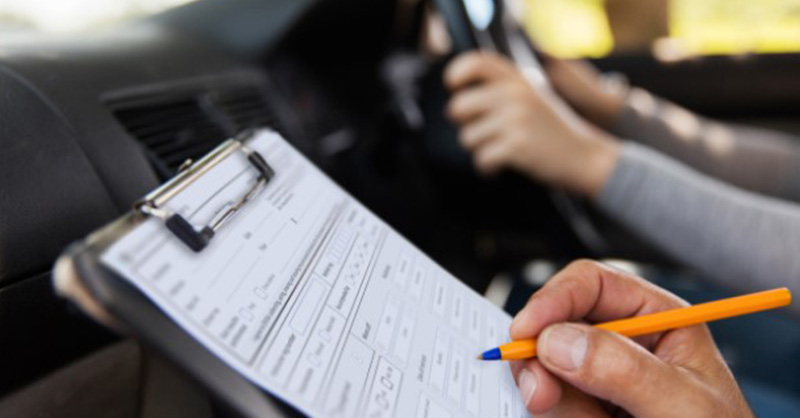
Mock driving test Cheetham Hill

What to Expect on Test Day

Your test begins with two "show me, tell me" vehicle safety questions worth one driving fault each if answered incorrectly. You then drive for approximately 40 minutes through North Manchester streets. Expect a mix of residential roads, main A-roads, at least one roundabout, and the independent driving section (following either a sat-nav or road signs for 20 minutes).

The examiner records driving faults (minor), serious faults, and dangerous faults on the DL25 marking sheet. You can accumulate up to 15 driving faults and still pass. A single serious or dangerous fault results in failure.

DriveSQ Cheetham Hill Preparation

  • £35/hr — manual or automatic, no surcharge
  • 10-hour block: £330 (save £20 vs hourly)
  • PassFirst guarantee — free additional lessons after a failed test
  • Mock tests on real Cheetham Hill routes
  • Test-morning warm-up lesson — arrive confident

A DriveSQ lesson on roads that feature in Cheetham Hill test routes.

Frequently Asked Questions

What is the Cheetham Hill test centre pass rate?
Cheetham Hill records a pass rate of approximately 38-42%, reflecting the demanding inner-city traffic conditions. Routes include heavy bus traffic, multi-lane junctions, and aggressive pedestrian crossings that challenge even confident learners.
Where is Cheetham Hill Test Centre?
Waterloo Road, Cheetham Hill, Manchester, M8 0PE. Street parking is limited — DriveSQ recommends your instructor drops you at the centre and parks nearby.
What are the hardest parts of Cheetham Hill routes?
Queens Road multi-lane junction, Cheetham Hill Road with double-parked vehicles, Bury Old Road speed management, and the Pin Mill Brow roundabout (5 exits) are consistently cited as the most challenging features.
Can I choose a different test centre instead of Cheetham Hill?
Yes. You can book your test at any UK test centre. If Cheetham Hill feels too demanding, West Didsbury or Sale may suit your confidence level better. DriveSQ can advise based on your current skill set.
Does DriveSQ do mock tests for Cheetham Hill?
Absolutely. We run full mock examinations on genuine Cheetham Hill routes, scored on the real DL25 marking sheet. Most DriveSQ learners complete at least two mocks before their actual test date.

Book Your Lesson with DriveSQ

DVSA-approved, £35/hr, door-to-door pickup across Greater Manchester.

WhatsApp Us 07352 932003

Cheetham Hill Local Area Guide

Lessons around Cheetham Hill use real local roads including Halliwell Lane, Waterloo Road and Derby Street, so by the time you're ready for your test you've already driven the streets you'll use every day after passing. The Manchester Jewish Museum on Cheetham Hill Road is housed in the city's oldest surviving synagogue building, a Grade II* listed Moorish-style former Spanish and Portuguese Synagogue built in 1874.

We also plan around school-run traffic near Crumpsall Lane Primary School and Cheetwood Primary School, using quieter spots like Manchester Jewish Museum for early manoeuvre practice before stepping up to busier sections of Halliwell Lane.

Test centre: most learners around Cheetham Hill test at Cheetham Hill (Manchester) Driving Test Centre, Alderglen Road, Cheetham, Manchester, M8 0AL; mock tests are planned around the routes examiners actually use from there.

“Recommend to anyone learning around Cheetham Hill — real local roads, real local knowledge, none of the guesswork.” – Hassan, Cheetham Hill
SQ Websites

Designed & Hosted by www.sqwebsites.co.uk

Crafted by Mohammed Qaim Abbas

Driving in Cheetham Hill — Local Knowledge That Matters

Cheetham Hill (M8) is a diverse north Manchester suburb adjacent to the DVSA test centre, with wholesale market traffic. Learner drivers in this area build their skills on real local roads including Bury New Road and Cheetham Hill Road, with Manchester Jewish Museum and Cheetham Hill Shopping Centre serving as practical navigation landmarks. Local knowledge is a genuine advantage when preparing for the DVSA practical test from Manchester Cheetham Hill Driving Test Centre.

Local road fact: The Manchester Jewish Museum on Cheetham Hill Road occupies a Grade II* listed former synagogue — the surrounding roads retain their 19th-century narrowness and require careful positioning to pass oncoming vehicles safely.

What this means for learners: Understanding local road patterns in Cheetham Hill is part of becoming a safe, confident driver. Cheetham Hill's wholesale markets on Smedley Lane and Irwell Street generate significant HGV and van traffic early each morning — a demanding environment for learners developing commercial vehicle proximity skills.

Queens Road provides a direct link between Cheetham Hill and Salford — its bus routes, pelican crossings and speed humps give a structured introduction to the full range of urban traffic controls.

Lessons in Cheetham Hill cover the full spectrum of road environments found in M8: residential side streets for early control practice, arterial roads for speed management and lane discipline, and local junctions that replicate the exact conditions assessed during the DVSA practical test. By the time you pass, every road in Cheetham Hill should feel familiar and manageable.

Key Driving Knowledge for Greater Manchester

Test centre facts: Greater Manchester has six DVSA practical test centres: Cheetham Hill (Manchester), West Didsbury, Sale, Stockport (Bredbury), Ashton-under-Lyne and Bolton. Each has distinct route characteristics — West Didsbury routes include dual carriageway sections; Cheetham Hill routes include complex urban multi-lane roads; Sale routes include water park approach roads. Choosing the right test centre for your training area is a strategic decision that can meaningfully affect your pass probability.

DriveSQ instructors covering Cheetham Hill bring detailed knowledge of M8 roads to every lesson. Queens Road provides a direct link between Cheetham Hill and Salford — its bus routes, pelican crossings and speed humps give a structured introduction to the full range of urban traffic controls. This local expertise means your lessons are always targeted, relevant and directly applicable to the roads you will drive every day after passing.

Greater Manchester Road Network — Educational Guide

Greater Manchester's road network covers over 4,500 miles of road managed across ten metropolitan boroughs. The network includes motorways (M60, M62, M56, M61, M63), A-roads of regional importance (A6, A34, A56, A57, A580), and an extensive local road grid of B-roads and unclassified roads. Understanding the network hierarchy — and the different driving demands at each level — is a key part of driver education.

Manchester's city centre road network is managed by TfGM (Transport for Greater Manchester) using a SCOOT adaptive traffic signal system that responds to real-time vehicle detector data. This means signal phases can be shorter or longer than expected — learners should always approach signals prepared to stop rather than accelerating in anticipation of a green phase.

Emergency Stop and Control

The emergency stop is a controlled, maximum-effort braking manoeuvre that must bring the vehicle to rest in the shortest possible distance while maintaining steering control. On modern vehicles with Anti-lock Braking Systems (ABS), the correct technique is to press the brake pedal as hard and as quickly as possible and maintain full pressure — ABS prevents wheel lock by pulsing brake pressure automatically, so do not pump the brake. Without ABS, the threshold braking technique — pressing to just before lockup point and holding — is optimal for straight-line stopping. Steering control during an emergency stop allows the driver to maintain their lane position even when braking at maximum effort — this is a significant safety advantage over uncontrolled stops. The emergency stop may be requested by the examiner during a DVSA practical test by raising their hand and saying 'stop' — one in three candidates are asked to perform an emergency stop. After an emergency stop, before moving off again, check mirrors, signal and check both blind spots, as following vehicles may have pulled around or beside you during the stop.

Observation Skills

DVSA Practical Test — What You Need to Know

Driver fault accumulation is not linear in its impact on test result. A candidate with 14 driver faults (one below the fail threshold) passes with the same result as a candidate with zero driver faults. However, the driver faults recorded provide useful feedback — any category with three or more driver faults recorded by the examiner is typically highlighted for post-test improvement even when the test is passed.

After You Pass — What New Drivers Need to Know

After passing your driving test, your journey as a driver is just beginning. The first year of independent driving carries the highest collision risk of any stage of a driver's career — new drivers are involved in road incidents at four times the rate of experienced drivers. Post-pass programmes including Pass Plus, motorway lessons with a qualified ADI, and telematics (black box) insurance all demonstrably reduce first-year risk. DriveSQ offers post-pass sessions specifically designed to build the additional skills that DVSA testing cannot fully assess: motorway driving, night driving, rural roads and adverse weather confidence.