Master every route from Sale Test Centre on Washway Road. Our instructors drive these routes weekly and know every junction, roundabout, and tricky spot that examiners use. This guide gives you the inside knowledge to pass at Sale.
Sale Test Centre is located on Washway Road, Sale, M33 7SS, in the heart of Trafford. The centre sits on the A56, one of the busiest arterial roads in south Manchester, which means your test begins and ends on a road that demands immediate concentration and confident driving from the very first moment.
The test centre is conveniently situated near Sale Metrolink station, just a short walk from the tram stop. If you are arriving by car, the centre is easily accessed from the A56 heading south from Stretford or north from Altrincham. There is a small car park at the centre, though spaces fill quickly on busy test days. Street parking is available on nearby residential roads off Washway Road, but check for restrictions during weekday hours.
The centre has a small but functional waiting room where candidates can sit before their test. There are toilet facilities available. The car park accommodates a limited number of vehicles, so arriving 10-15 minutes early is advisable rather than 30 minutes, as you may struggle to find a space. Your DriveSQ instructor will drop you at the door and park nearby, then meet you with the car when the examiner is ready.
Sale Test Centre records a pass rate of approximately 47%, which is slightly above the national average of around 45%. This makes Sale one of the more favourable test centres in the Greater Manchester area. However, the routes are by no means easy. The combination of dual carriageway driving on Washway Road, complex roundabouts near Brooklands, and narrow residential streets with heavy parking creates a genuine test of all-round driving ability. Learners who prepare specifically for Sale routes consistently outperform those who rely on general driving skills alone.
These are the most commonly used routes from Sale Test Centre. DriveSQ instructors practise every one of these during your lessons so nothing comes as a surprise on test day.
This is the most frequently used route from Sale Test Centre and the one that catches the most learners off guard. You leave the test centre turning left onto Washway Road (A56) heading south towards Brooklands. The road is a busy dual carriageway with a 30 mph speed limit through the town centre section, increasing to 40 mph as you approach the Brooklands area. Within the first few hundred metres, you will encounter bus lanes on the nearside that operate during peak hours — entering an active bus lane is an immediate serious fault.
The route continues along Washway Road past Sale Metrolink stop, where you must watch for pedestrians crossing to and from the tram platform. At the Brooklands Road junction, you turn left onto Brooklands Road, a quieter residential road with speed humps and parked cars on both sides. The examiner is looking for your ability to transition from a fast-moving dual carriageway to a narrow residential street without losing composure.
From Brooklands Road, the route typically takes you onto Marsland Road, which connects back towards Washway Road via a series of traffic-light-controlled junctions. The Marsland Road / Brooklands Road roundabout is a key assessment point — it is a mini-roundabout with poor visibility from the Brooklands Road approach due to parked vehicles and a slight curve. You must approach slowly, check right thoroughly, and be prepared to give way to traffic already on the roundabout. Many learners fail here by either hesitating too long or pulling out without adequately checking.
This route tests your ability to handle narrow residential streets, school zones, and tight junctions. From the test centre, you turn right onto Washway Road and almost immediately take a left onto Cross Street. This is a narrow residential road lined with terraced houses and heavy on-street parking on both sides. The effective road width is often reduced to a single lane, requiring you to judge gaps, give way to oncoming traffic, and use meeting points competently.
Cross Street leads into the School Road (B5166) area, where you will pass Sale Grammar School and Worthington Primary School. During school hours (8:00-9:00 and 14:30-15:30), these roads are extremely busy with parents parking, children crossing, and lollipop patrols operating. The examiner will assess your speed management — you should be driving well below the 30 mph limit in these zones, typically 15-20 mph, with your foot covering the brake and constant scanning for children stepping out between parked cars.
The route loops through residential streets including Woodheys Drive and Harboro Road before returning to School Road and eventually back to Washway Road. These streets feature multiple T-junctions with limited visibility, requiring the MSPSL (Mirror, Signal, Position, Speed, Look) routine at every turn. Parked vans and SUVs frequently obscure sightlines at these junctions, so the examiner expects to see you creeping forward to establish a clear view before committing to any turn.
This route takes you south along the A56 corridor towards Altrincham, testing your dual carriageway skills and ability to handle busy roundabouts. You exit the test centre turning left onto Washway Road and continue south past Dane Road Metrolink stop. At the Dane Road / Washway Road traffic lights, the route turns left onto Dane Road, which runs parallel to the Metrolink line.
Dane Road has Metrolink tram crossings that are controlled by traffic signals. You must approach these crossings at a reduced speed, obey the traffic lights precisely, and never stop your vehicle on the tram tracks — even in slow-moving traffic. Trams approach quietly and cannot swerve, so the examiner is looking for active awareness rather than passive observation.
The route then joins the A56 dual carriageway heading towards Altrincham. This section has a 40 mph speed limit and features slip road merges that require confident mirror use and timely speed matching. You must demonstrate that you can join the flow of faster traffic smoothly without causing vehicles behind to brake. The examiner will also test your ability to change lanes safely — checking mirrors, signalling in good time, and moving across decisively rather than drifting or hesitating mid-manoeuvre. The return journey includes a roundabout at Navigation Road where lane discipline is critical: the left lane feeds onto Washway Road north, and the right lane continues towards Altrincham town centre.
This route heads east from the test centre towards Northenden and Sale Moor, covering a mix of suburban roads and busier through-routes. From Washway Road, you take Northenden Road heading east. This is a wide road with a 30 mph limit that passes through a largely residential area. Parked cars on the nearside require frequent position adjustments, and the road has several pedestrian crossings where the examiner will observe your approach speed and awareness.
At the Northenden Road / Rifle Road junction, the route turns onto Rifle Road, a narrower residential street that winds through the Sale Moor area. This section tests your steering precision and spatial awareness — the road curves gently with parked cars requiring you to constantly reassess your road position. Speed humps every 50-80 metres mean you must moderate your speed consistently rather than braking harshly at each hump.
The route continues through Sale Moor village, where the narrow shopping street creates pinch points as delivery vehicles and shoppers occupy the road space. From Sale Moor, the return journey takes you along Broad Road past Broad Road Park, then back onto Northenden Road and towards the test centre via Washway Road. The final approach back to the test centre on Washway Road northbound requires a right turn across oncoming traffic — the examiner is assessing whether you choose a safe gap and commit to the turn without unnecessary delay.
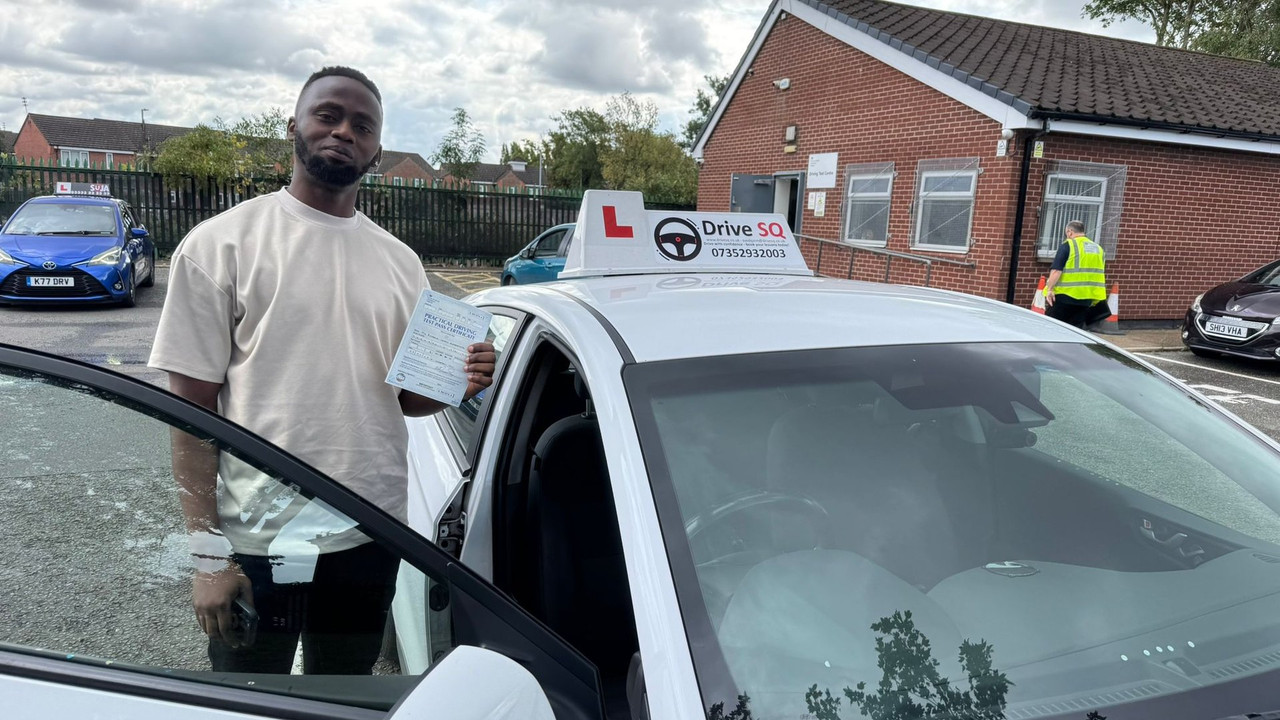
DriveSQ instructors share the Sale-specific tips that help our learners pass first time.
These are the most common fail locations on Sale test routes. DriveSQ practises each one until your response is automatic.
Common questions about taking your driving test at Sale Test Centre.
Genuine reviews from DriveSQ learners who took their test at Sale Test Centre.
Same price across all Manchester postcodes. No hidden fees. Test day car included.
£33/hr · Sale Test Routes Covered · DVSA Approved · 90%+ Pass Rate
WhatsApp Us Now Call 07352 932003DriveSQ covers all of Greater Manchester. Find lessons near you.
Lessons around Sale use real local roads including Cross Street, Marsland Road and Northenden Road, so by the time you're ready for your test you've already driven the streets you'll use every day after passing. Sale sits on the line of the old Roman road linking the forts at Chester and Manchester, and the modern A56 through the town still follows that ancient route.
We also plan around school-run traffic near St Joseph's Catholic Primary School and Springfield Primary School, using quieter spots like Sale Town Hall for early manoeuvre practice before stepping up to busier sections of Cross Street.
Test centre: most learners around Sale test at Sale (Manchester) Driving Test Centre, 36-38 Poplar Grove, Sale, M33 7ER; mock tests are planned around the routes examiners actually use from there.
“My instructor knew exactly which junctions near St Joseph's Catholic Primary School get busy at school-run time and planned around them.” – Aisha, Sale
Sale (M33) is a mature suburban town with water park, retail park access and dual carriageways. Learner drivers in this area build their skills on real local roads including Dane Road and School Road, with Sale Moor and Sale Water Park serving as practical navigation landmarks. Local knowledge is a genuine advantage when preparing for the DVSA practical test from Sale Driving Test Centre.
Local road fact: Sale's DVSA test centre on Cross Street is among the most active in the region, with routes extending along Washway Road (A56) and up to the M60 slip roads.
What this means for learners: Understanding local road patterns in Sale is part of becoming a safe, confident driver. The A56 Washway Road is a dual carriageway with a 50mph section near the M60 — learners must demonstrate safe overtaking, lane discipline and motorway-style merging during test prep.
Sale Water Park covers 160 acres and was created from gravel extraction pits — the roads surrounding it, including Rifle Road, feature sharp bends and poor sight lines.
Lessons in Sale cover the full spectrum of road environments found in M33: residential side streets for early control practice, arterial roads for speed management and lane discipline, and local junctions that replicate the exact conditions assessed during the DVSA practical test. By the time you pass, every road in Sale should feel familiar and manageable.
Test centre facts: Greater Manchester has six DVSA practical test centres: Cheetham Hill (Manchester), West Didsbury, Sale, Stockport (Bredbury), Ashton-under-Lyne and Bolton. Each has distinct route characteristics — West Didsbury routes include dual carriageway sections; Cheetham Hill routes include complex urban multi-lane roads; Sale routes include water park approach roads. Choosing the right test centre for your training area is a strategic decision that can meaningfully affect your pass probability.
DriveSQ instructors covering Sale bring detailed knowledge of M33 roads to every lesson. Sale Water Park covers 160 acres and was created from gravel extraction pits — the roads surrounding it, including Rifle Road, feature sharp bends and poor sight lines. This local expertise means your lessons are always targeted, relevant and directly applicable to the roads you will drive every day after passing.
History: Sale was an important crossing point of the River Mersey for centuries — the name derives from Old English 'salh' meaning willow tree, reflecting the willows that once lined the Mersey bank at the original ford.
Transport links: Sale Metrolink station connects Sale to Manchester city centre in 17 minutes — the tram infrastructure along School Road creates pedestrian crossing points that require learners to yield to passengers crossing between the platform and town centre.
Key road to know: The A56 Washway Road between Sale and Manchester is one of the most monitored roads in Greater Manchester for average speed — learners must understand average speed camera systems, which measure time between two points rather than speed at a single location.
Parking in Sale: Sale's town centre car parks include Sale Water Park surface car park — learners benefit from practising here because the same large-bay car park is used in driving instruction from the Sale DVSA test centre.
Weather and road conditions: Sale's proximity to the Manchester Ship Canal creates fog conditions on winter mornings — the towpath roads including Britannia Road require fog light activation when visibility drops, which learners must recognise by windscreen misting and reduced sight distance.
Roundabouts are one of the most statistically safe junction types — they reduce fatal collision risk by up to 75% compared to signal-free crossroads. However, they are also one of the most commonly misunderstood features of UK roads. The fundamental rule is that circulating traffic (already on the roundabout) has priority over entering traffic. Signal use at roundabouts follows a specific code: signalling left when taking the first exit, signalling left after the last exit before your own, and keeping no signal until past the last exit for exits beyond 12 o'clock. Approaching lane selection at a roundabout should be determined by your exit direction: left-hand exits typically use the left lane, right-hand exits typically use the right lane, and 12 o'clock exits can use either lane depending on road markings. At mini-roundabouts, all vehicles must circulate clockwise but the roundabout is too small to realistically circulate — in practice, drivers yield to right and then pass over the marking if space permits. Double mini-roundabouts are treated as two separate junctions.
The independent driving section introduced in 2017 has significantly changed test preparation. Approximately 80% of independent driving is conducted using a sat-nav (a TomTom provided by the examiner). The remaining 20% uses road signs and verbal instruction from the examiner. In either case, following an incorrect turn does not automatically result in a fault — what is assessed is how safely the driver responds to having made the error, not the navigation error itself.
The green novice driver plate (displayed voluntarily by new drivers) has no legal status in England, Scotland and Wales but is widely respected by other drivers. Northern Ireland requires new drivers to display R plates for two years after passing. The DVSA recommends new drivers consider using N-plates or green P-plates for at least three months to encourage following drivers to give additional space and patience. The plate also serves as a self-reminder — research shows drivers who display a novice plate in the first months after passing drive more carefully and have fewer incidents.