West Didsbury Driving Test Centre — Complete Guide

Everything you need to know about passing your practical driving test at West Didsbury. Routes, tricky spots, pass rates, and insider tips from DriveSQ instructors who drive these roads every single day.

Test Centre Essential Information

Address

Christie Fields, Derwent Avenue, West Didsbury, Manchester, M21 7NP

Facilities

Male and female toilets. Small waiting area. Dedicated DVSA parking — arrive no more than 10 minutes early.

Pass Rate

40-43% historically — below the 48% national average due to complex South Manchester roads. DriveSQ learners consistently exceed this.

Test Duration

Approximately 40 minutes, covering around 8 miles of South Manchester roads including residential, main roads, and dual carriageways.

Top 4 Tricky Spots on West Didsbury Routes

1. Princess Parkway (A5103) Slip Roads

The Princess Parkway is a major dual carriageway carrying fast-moving traffic between the M56 and Manchester city centre. Examiners frequently ask candidates to join or exit the Parkway near Didsbury. The challenge is twofold: matching the speed of traffic already on the carriageway during the merge, and managing the sudden speed reduction from 50mph to 30mph when exiting back towards residential Didsbury.

DriveSQ prepares you by practising the specific slip roads used on test routes. We teach progressive acceleration during the merge — building speed through the gears on the slip road so you reach traffic speed before the merge point. For exits, we drill the mirror-signal-decelerate sequence, emphasising the speed limit drop that catches unprepared candidates.

DriveSQ Tip: When exiting Princess Parkway towards Didsbury, the speed drops from 50mph to 30mph within 100 metres. Fixed speed cameras enforce this transition — start braking before the slip road, not on it.

2. Barlow Moor Road (A5145) Junctions

Barlow Moor Road cuts through South Manchester past Christie Hospital and into Didsbury village. It carries heavy traffic at most hours, with frequent bus stops, pedestrian crossings, and cyclists. The junctions where side roads meet Barlow Moor Road demand excellent observation because traffic approaches from both directions at speed, and gaps close faster than nervous learners expect.

DriveSQ teaches the "committed emergence" technique for these junctions. You assess the gap, make your decision, and execute without hesitation. Half-hearted pulls into fast-moving traffic are more dangerous than waiting for a clearer gap. We practise each junction until your gap judgement is reliable and your execution is decisive.

3. Narrow Residential Streets of Withington and Chorlton

Many West Didsbury routes head north into the tight residential grid where cars park on both sides, reducing two-lane roads to single-track. Meeting situations — where you encounter an oncoming vehicle and one of you must give way — test your judgement under pressure. The examiner assesses whether you recognise the priority situation early enough, pull into a gap smoothly, and use appropriate observation before moving off again.

"The residential streets around Withington were my biggest fear. DriveSQ took me through them dozens of times until I could handle meeting situations without panicking. The test felt easy by comparison."

— Sophie, Withington

4. Burton Road / Nell Lane Roundabout

This busy local roundabout sits near the Metrolink tram lines and carries traffic from multiple directions. Cyclists frequently use the roundabout, and rapid traffic from the right demands confident gap assessment. Rushing a gap here — pulling out before a vehicle from the right has fully cleared — is one of the most common serious faults recorded at West Didsbury.

DriveSQ teaches a deliberate approach: arrive at the give-way line, check right, check ahead, check right again, and only proceed when the gap is genuinely clear. Taking an extra three seconds at the line is far better than a serious fault for junction entry.
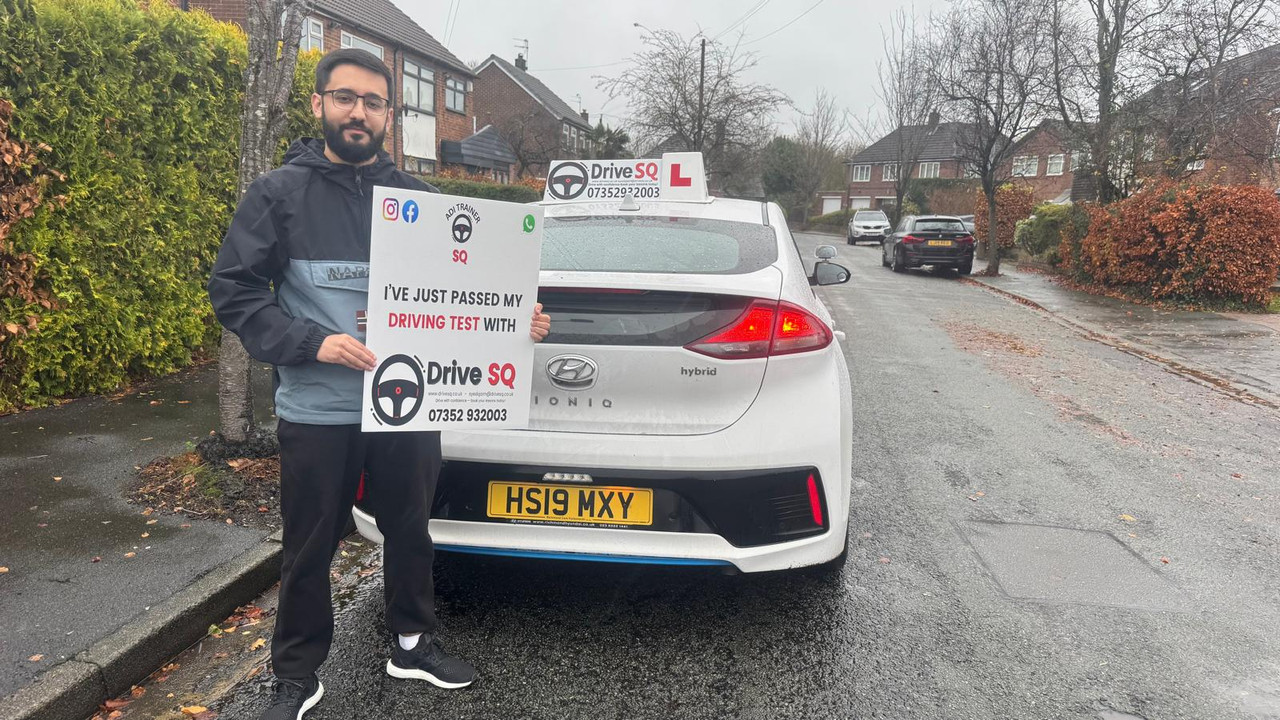
DriveSQ car on West Didsbury test route

Test-Day Manoeuvres

The examiner will request one reversing manoeuvre during your test. At West Didsbury, the most common are:

Parallel parking: Usually on a quieter residential street off Cavendish Road or Lapwing Lane. DriveSQ teaches a reference-point method that works consistently regardless of the street chosen.

Bay parking: Forward or reverse bay parking in the Christie Fields car park itself, typically at the very start or end of your test. DriveSQ practises both in this specific car park so the layout is familiar.

Pull up on the right: On a quiet residential road. Pull across to the right side, reverse two car lengths, then rejoin traffic safely. Observation is the critical element — check every blind spot before any movement.

3 Golden Tips to Pass First Time

Time Your Test Wisely

Book between 10:00 and 14:00 to avoid school-run congestion on Barlow Moor Road and rush-hour gridlock on Princess Parkway. Midweek tests are generally calmer than Monday or Friday.

Master Yellow Box Junctions

Several junctions near Didsbury and Fallowfield have yellow box markings. Never enter unless your exit is completely clear — blocking a yellow box is an instant serious fault.

Take a DriveSQ Mock Test

A full 40-minute mock on real West Didsbury routes eliminates surprises on test day. DriveSQ scores you on the official DL25 sheet and targets your weakest areas in remaining lessons.

DriveSQ West Didsbury Area Offers

  • £35/hr — manual or automatic, same price
  • 10-hour block: £330 (save £20)
  • PassFirst guarantee — free support lessons if you fail
  • Mock tests on actual West Didsbury routes included
  • Test-day warm-up lesson included on test morning

DriveSQ lesson footage on roads used in West Didsbury test routes.

Frequently Asked Questions

What is the pass rate at West Didsbury?
West Didsbury historically records a pass rate between 40% and 43%, slightly below the national average of 48%. This reflects the complex South Manchester road network rather than examiner strictness. DriveSQ learners consistently beat this average through targeted route preparation.
Where exactly is West Didsbury Test Centre?
Christie Fields, Derwent Avenue, West Didsbury, Manchester, M21 7NP. The centre has dedicated DVSA parking, male and female toilets, and a small waiting area. Arrive no more than 10 minutes before your test time.
What manoeuvres are tested at West Didsbury?
The examiner will ask for one reversing manoeuvre: parallel park, forward bay park, reverse bay park, or pull up on the right and reverse. Bay parking often takes place in the Christie Fields car park itself.
How long is the driving test from West Didsbury?
Approximately 40 minutes covering around 8 miles. Routes include residential Didsbury streets, Barlow Moor Road, sections of Princess Parkway, and Chorlton-area junctions.
Does DriveSQ offer mock tests on West Didsbury routes?
Yes. DriveSQ runs full 40-minute mock examinations replicating real West Didsbury routes. We use the official DL25 marking sheet and debrief your weakest areas afterwards. Most learners take 2-3 mocks before their actual test.

Book Your Lesson with DriveSQ

DVSA-approved, £35/hr, door-to-door pickup across Greater Manchester.

WhatsApp Us 07352 932003

West Didsbury Local Area Guide

Lessons around West Didsbury use real local roads including Princess Parkway, Barlow Moor Road and Palatine Road, so by the time you're ready for your test you've already driven the streets you'll use every day after passing. West Didsbury barely existed before about 1860 — it grew rapidly in the late Victorian era as Manchester's cotton wealth spread south, and its own DVSA driving test centre now sits right in the heart of the area on Christie Park.

We also plan around school-run traffic near Beaver Road Primary School and Cavendish Community Primary School, using quieter spots like Christie Park for early manoeuvre practice before stepping up to busier sections of Princess Parkway.

Test centre: most learners around West Didsbury test at West Didsbury Driving Test Centre, Unit 11, Christie Park, West Didsbury, M21 7QY; mock tests are planned around the routes examiners actually use from there.

“Booking was easy and my instructor adapted lessons around Beaver Road Primary School traffic without me even having to ask.” – Sam, West Didsbury
SQ Websites

Designed & Hosted by www.sqwebsites.co.uk

Crafted by Mohammed Qaim Abbas

Driving in West Didsbury — Local Knowledge That Matters

West Didsbury (M20) is a affluent village suburb adjacent to the DVSA test centre, with village high street and hospital proximity. Learner drivers in this area build their skills on real local roads including Barlow Moor Road and Palatine Road, with River Mersey (Didsbury) and Christie Hospital serving as practical navigation landmarks. Local knowledge is a genuine advantage when preparing for the DVSA practical test from West Didsbury Driving Test Centre.

Local road fact: Barlow Moor Road transitions from a narrow village road to a wider suburban arterial as it heads north toward Chorlton — learners practise adjusting their speed and positioning as road character changes.

What this means for learners: Understanding local road patterns in West Didsbury is part of becoming a safe, confident driver. The Christie Hospital, one of Europe's leading cancer research centres, sits at the junction of Wilmslow Road and Christie Park Avenue — patient transport vehicles are a continuous presence, requiring learners to anticipate slow-moving medical vehicles.

West Didsbury Driving Test Centre on Cavendish Road is one of the busiest DVSA centres in the North West — its test routes use Burton Road, Barlow Moor Road, Palatine Road and residential streets through Withington and Northenden.

Lessons in West Didsbury cover the full spectrum of road environments found in M20: residential side streets for early control practice, arterial roads for speed management and lane discipline, and local junctions that replicate the exact conditions assessed during the DVSA practical test. By the time you pass, every road in West Didsbury should feel familiar and manageable.

Key Driving Knowledge for Greater Manchester

Road safety facts: Young drivers (17-24) represent 7% of all UK licence holders but are involved in 25% of fatal road collisions. The primary risk factors are inexperience, peer pressure, night driving and driving on high-speed rural roads. Comprehensive training that includes night driving, rural roads and post-test motorway experience directly addresses all four risk factors.

DriveSQ instructors covering West Didsbury bring detailed knowledge of M20 roads to every lesson. West Didsbury Driving Test Centre on Cavendish Road is one of the busiest DVSA centres in the North West — its test routes use Burton Road, Barlow Moor Road, Palatine Road and residential streets through Withington and Northenden. This local expertise means your lessons are always targeted, relevant and directly applicable to the roads you will drive every day after passing.

More About West Didsbury — Driving Context

History: West Didsbury was developed primarily in the 1890s as Manchester's middle classes moved south along the Wilmslow Road tramway — its Arts and Crafts and late Victorian architecture gives it a consistent built character that has been preserved as a Conservation Area.

Transport links: The West Didsbury Metrolink stop on the Airport line opened in 2013, transforming accessibility — the stop's Park and Ride facility on Burton Road includes 200 spaces and creates morning parking pressure on surrounding residential streets.

Key road to know: Cavendish Road, location of West Didsbury DVSA test centre, is a quiet residential street — learners who have never driven on it before their test may be disoriented, so pre-test familiarisation drives past the test centre are strongly recommended.

Parking in West Didsbury: Burton Road's village centre parking bays are among the most competed-for in south Manchester — learners who can successfully parallel park in Burton Road's narrow bays in peak hours can park anywhere in the city.

Weather and road conditions: West Didsbury's Mersey-adjacent properties on Barlow Moor Road near the river are in Flood Risk Zone 2 — learners are taught to identify the road closures that occur during high-water events and use alternative routes.

Understanding Speed Limits

Speed limits are one of the most frequently misunderstood aspects of UK driving law. A speed limit is not a target or a recommended speed — it is the absolute maximum permitted in ideal conditions. Drivers must reduce speed below the limit whenever conditions demand it: rain, fog, pedestrians near the carriageway, reduced visibility, bends with limited forward sight distance, or approaching school zones. The National Speed Limit (NSL) sign — a white circle with a diagonal red stripe — means 60mph on single-carriageway roads and 70mph on dual carriageways and motorways for cars. Variable speed limits on smart motorways are legally enforceable and treated identically to static speed limits. Average speed camera systems measure elapsed time between detection points — slowing for a camera and accelerating away defeats them completely. Fixed point cameras use a 10% + 2mph tolerance, but this is not a legal allowance and varies by enforcement policy. The safest approach is to drive at the speed that allows you to stop within the distance you can see to be clear — a principle that applies regardless of the posted limit.

Observation Skills

DVSA Practical Test — What You Need to Know

Driver fault accumulation is not linear in its impact on test result. A candidate with 14 driver faults (one below the fail threshold) passes with the same result as a candidate with zero driver faults. However, the driver faults recorded provide useful feedback — any category with three or more driver faults recorded by the examiner is typically highlighted for post-test improvement even when the test is passed.

After You Pass — What New Drivers Need to Know

After passing your driving test, your journey as a driver is just beginning. The first year of independent driving carries the highest collision risk of any stage of a driver's career — new drivers are involved in road incidents at four times the rate of experienced drivers. Post-pass programmes including Pass Plus, motorway lessons with a qualified ADI, and telematics (black box) insurance all demonstrably reduce first-year risk. DriveSQ offers post-pass sessions specifically designed to build the additional skills that DVSA testing cannot fully assess: motorway driving, night driving, rural roads and adverse weather confidence.