Choosing a driving school in Manchester is a big decision — you are investing £1,000+ and dozens of hours. Here is why DriveSQ consistently ranks as Manchester's top-rated driving school.
What Makes DriveSQ Different?
90%+ First-Time Pass Rate
Our structured teaching method, mock tests, and test-route practice mean most DriveSQ learners pass on their first attempt — well above the national 49% average.
PassFirst Guarantee
Our exclusive ⚡ PassFirst package includes FREE support lessons if you don't pass first time. No other Manchester school offers this.
Transparent Pricing
£35/hr for manual OR automatic — same price. 10-hour blocks from £330. No fuel surcharges, no hidden fees, no cancellation traps.
Instant WhatsApp Booking
Message us on WhatsApp and get a reply within minutes. No call centres, no hold music, no waiting days for a callback.
All Manchester Areas
From Didsbury to Prestwich, Sale to Ashton, our instructors cover all of Greater Manchester. Door-to-door pickup included.
DVSA Green-Badge Instructors
Every DriveSQ instructor holds the highest DVSA qualification. Grade A instructors with years of Manchester teaching experience.
Our Competitive Advantages
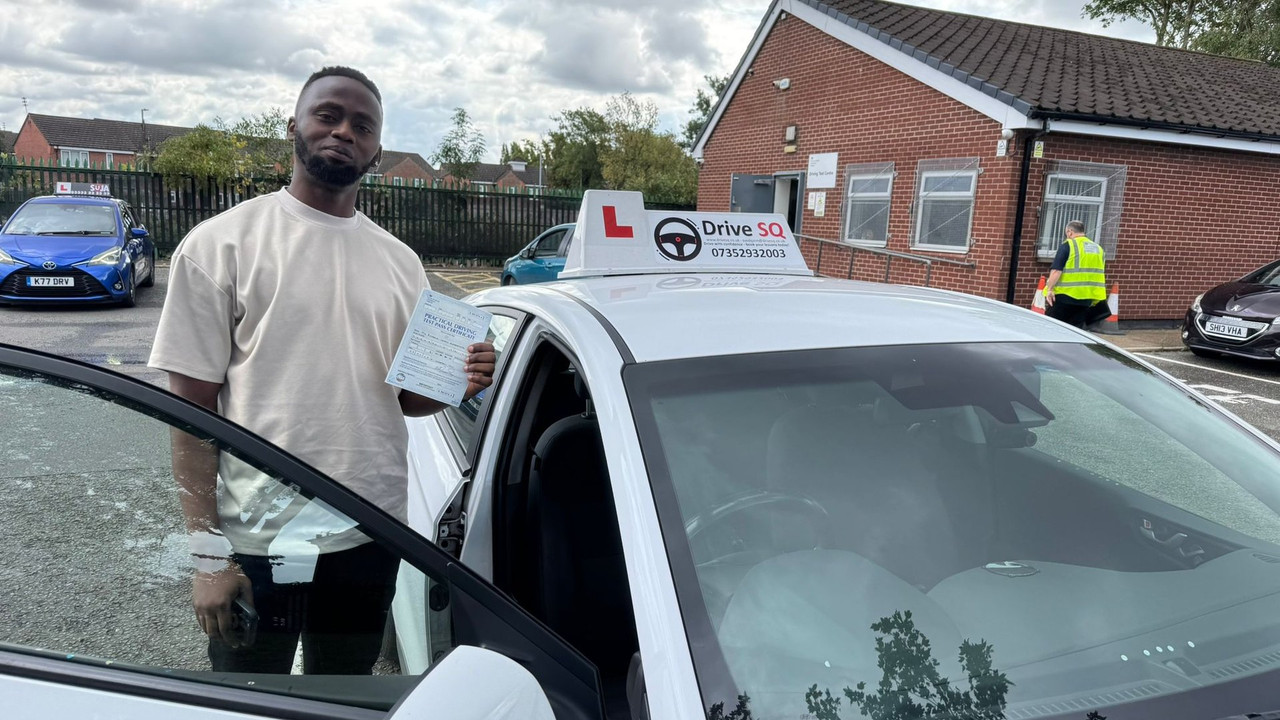
- Same price for automatic and manual — most competitors charge £2-5 more for auto
- FREE support lessons on the PassFirst package — unique to DriveSQ
- Modern dual-controlled cars with air conditioning and easy controls
- Test-route specialists at every Manchester centre (Cheetham Hill, West Didsbury, Sale, Bredbury, Failsworth, Hyde)
- Evening and weekend availability — 7 days a week
- Student-friendly — pickup from UoM, MMU, Salford, and Bolton campuses
- Theory support included — we integrate theory into practical lessons
- Progress tracking app — see exactly where you stand at all times
What Our Learners Say
Compare Manchester Driving Schools
| Feature | DriveSQ | Typical Competitor |
|---|---|---|
| Price per hour | £35 | £35-£42 |
| Auto surcharge | None | £2-5 extra |
| Free lessons if fail | Yes (PassFirst) | No |
| WhatsApp booking | Instant reply | Phone only |
| Mock tests | Included | Extra charge |
| Evening/weekend | 7 days | Mon-Sat |
| DVSA grade | Grade A | Varies |
Book With DriveSQ Today
Manchester's top-rated driving school. DVSA-approved, 90%+ pass rate, instant WhatsApp booking.
WhatsApp Us Now Call 07352 932003Manchester City Centre Local Area Guide
Lessons around Manchester city centre use real local roads including Deansgate, Princess Street and Mosley Street, so by the time you're ready for your test you've already driven the streets you'll use every day after passing. Manchester's Free Trade Hall on Peter Street stands on the exact site of the 1819 Peterloo Massacre, where cavalry charged a crowd of around 60,000 peaceful protesters demanding parliamentary reform.
We also plan around school-run traffic near The Cathedral School of St Peter and St John RC Primary and Chetham's School of Music, using quieter spots like Manchester Town Hall for early manoeuvre practice before stepping up to busier sections of Deansgate.
Test centre: most learners around Manchester city centre test at Cheetham Hill Driving Test Centre, Alderglen Road, Cheetham, Manchester, M8 0AL; mock tests are planned around the routes examiners actually use from there.
“Booking was easy and my instructor adapted lessons around The Cathedral School of St Peter and St John RC Primary traffic without me even having to ask.” – Jade, Manchester City Centre
Local Road Knowledge and Driving Education
Building local road knowledge is one of the most underestimated aspects of driver training. Knowing which junctions require extra observation, where speed limits change, and where vulnerable road users are most likely to appear turns a competent learner into a genuinely safe driver for life. DriveSQ lessons are planned around the actual roads you will drive every day after passing.
Key Driving Knowledge for Greater Manchester
- Mirror checks should happen every 5-8 seconds on open roads and before every speed change, direction change or manoeuvre.
- The DVSA's recommended following distance is a 2-second gap in dry conditions — double it in rain and triple it in snow or ice.
- Speed limits are maximums, not targets — always drive at the speed appropriate for the road conditions, visibility and traffic density.
- Highway Code Rule 170 requires you to give way to pedestrians when turning into a side road if they are already crossing.
Road safety facts: Young drivers (17-24) represent 7% of all UK licence holders but are involved in 25% of fatal road collisions. The primary risk factors are inexperience, peer pressure, night driving and driving on high-speed rural roads. Comprehensive training that includes night driving, rural roads and post-test motorway experience directly addresses all four risk factors.
DriveSQ instructors bring nationally-accredited teaching methodology to every lesson, combined with deep local knowledge of Greater Manchester roads. Every lesson is planned to build on the previous one, creating a progressive learning journey from first drive to test-ready confidence.
Greater Manchester Road Network — Educational Guide
Greater Manchester's road network covers over 4,500 miles of road managed across ten metropolitan boroughs. The network includes motorways (M60, M62, M56, M61, M63), A-roads of regional importance (A6, A34, A56, A57, A580), and an extensive local road grid of B-roads and unclassified roads. Understanding the network hierarchy — and the different driving demands at each level — is a key part of driver education.
Manchester's city centre road network is managed by TfGM (Transport for Greater Manchester) using a SCOOT adaptive traffic signal system that responds to real-time vehicle detector data. This means signal phases can be shorter or longer than expected — learners should always approach signals prepared to stop rather than accelerating in anticipation of a green phase.
Vehicle Safety Checks
Pre-drive vehicle safety checks are not just a driving test requirement — they are a legal responsibility for every driver every time they drive. The DVSA's recommended pre-drive checks can be remembered as POWDERS: Petrol (or charge level for EVs), Oil, Water (coolant and windscreen wash), Damage (visible exterior damage that might affect road safety), Electrics (lights, indicators, horn), Rubber (tyres and wiper blades), and Seatbelts (and mirrors). Oil level should be checked on a level surface with the engine cold — the dipstick should show oil between the minimum and maximum marks; below minimum requires immediate topping up before driving. Tyre pressure should be checked monthly and before long journeys using a calibrated gauge — the correct pressure for your vehicle is found in the owner's manual, on the door jamb sticker, or inside the fuel filler cap. Windscreen wash concentration should be set to the appropriate dilution for the season — in winter, a 50/50 antifreeze-to-water mix prevents washer fluid from freezing in the nozzles at temperatures below -10°C. Working headlights, brake lights and indicators are legal requirements — checking them regularly using a wall reflection at night or asking a helper to confirm operation keeps you legal and safe.
Lane Discipline Essentials
- Hatched areas (diagonal white lines inside a solid white border) must not be entered except in an emergency — hatching inside a broken white border may be entered if safe and necessary.
- Bus lanes that operate during off-peak hours may be used by general traffic outside their hours of operation — always check the hours-of-operation sign before entering a bus lane.
- The left lane on any multi-lane road (including dual carriageways) is the correct lane for normal driving — the centre and right lanes are overtaking lanes only.
- If you are in the right lane of a three-lane motorway and a vehicle behind signals to overtake, you should return to the middle lane and then the left lane as soon as it is safe to do so.
DVSA Practical Test — What You Need to Know
The eyesight test at the start of a DVSA practical test requires the candidate to read a standard number plate from 20 metres. This equates to approximately 5 car lengths. Candidates who wear glasses or contact lenses must wear them during the test — failure to do so when the eyesight check result requires correction constitutes grounds for terminating the test. Candidates who fail the eyesight test do not receive a refund of their test fee.
After You Pass — What New Drivers Need to Know
Vehicle maintenance responsibility transfers entirely to the driver after passing — and many new drivers are unaware of what this involves. Key monthly checks: tyre pressure (including spare), tyre tread depth (legal minimum 1.6mm across the central 75% of the tread width and around the entire circumference), oil level, coolant level, windscreen washer fluid, and all lights. Annual MOT from year three, six-monthly visual tyre inspection, and a full service to manufacturer's schedule. Driving a vehicle with a tyre tread below 1.6mm carries a £2,500 fine and three penalty points per tyre — four defective tyres could mean 12 points and licence revocation for a newly qualified driver.