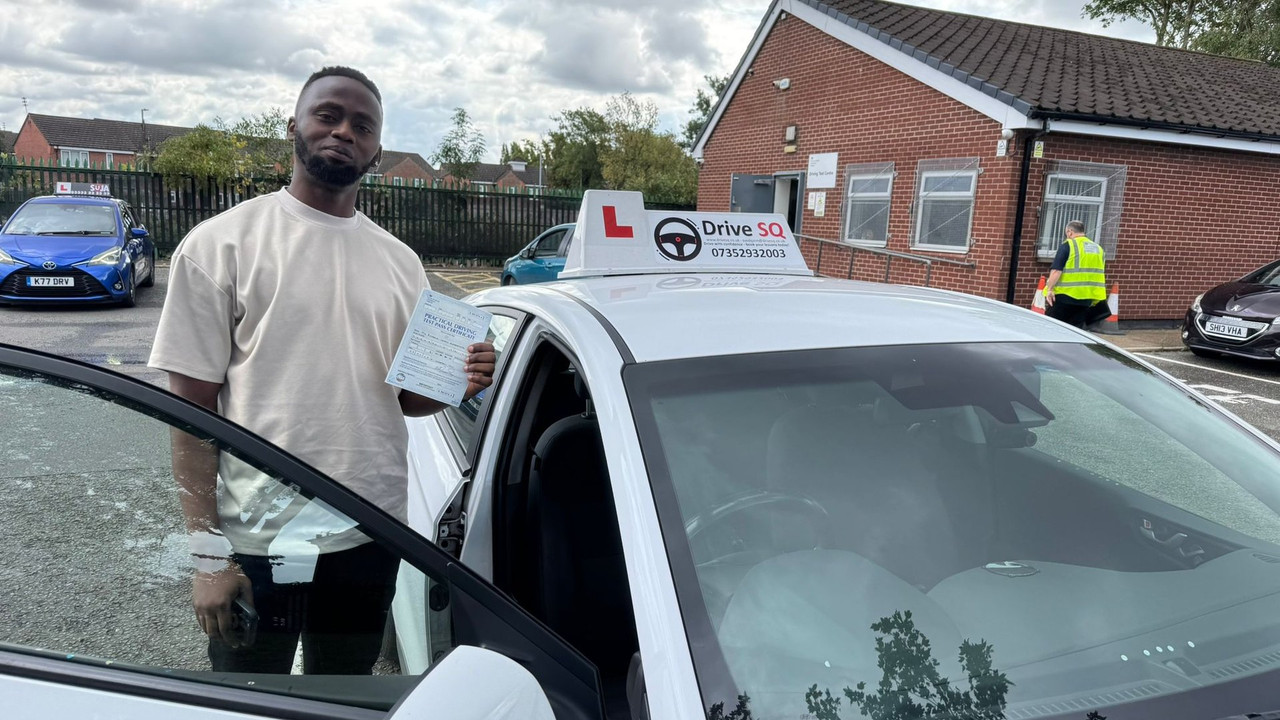
Driving Lessons for Manchester University Students

Manchester has over 100,000 university students across UoM, MMU, Salford, and Bolton. Learning to drive while at uni is smart: you have flexible hours, a...

Why Learn to Drive at Uni?

Manchester has over 100,000 university students across UoM, MMU, Salford, and Bolton. Learning to drive while at uni is smart: you have flexible hours, a permanent address for your provisional licence, and a driving licence is increasingly required for graduate jobs. Plus, Manchester's road network gives you experience that transfers anywhere in the UK.
Why Learn to Drive at Uni?

Student-Friendly Features

DriveSQ is built for student life:


  • Campus pickup: We collect you from halls in Fallowfield, Rusholme, Victoria Park, Salford campus, or MMU Birley Fields

  • Flexible scheduling: Book around your lectures — early morning, lunch, evening, and weekend slots available

  • WhatsApp booking: No need to call during office hours. Message us anytime on 07352 932003

  • Pay-as-you-go or block: No long-term contracts. Book one lesson at a time or save with a 10-hour block (£330)

  • Holiday breaks: Going home for Christmas? Pause and resume when you're back. No penalties.

Student-Friendly Features

Best Areas to Learn Near Manchester Unis


  • UoM / Fallowfield halls: Lessons start on quiet Fallowfield side streets, progress to Wilmslow Road and Palatine Road. Test at West Didsbury.

  • MMU (All Saints/Birley): Start in Hulme residential streets, progress to Chester Road and Princess Road. Test at Cheetham Hill or Sale.

  • Salford Uni: Start in Salford Crescent area, progress to Chapel Street and Eccles New Road. Test at Eccles.

  • Bolton Uni: Start in quiet Bolton residential streets, progress to Deane Road and the A666. Test at Bolton.

Intensive Holiday Courses

Got a 3-week break between terms? Our intensive course fits 20-40 hours into one or two weeks. Many students arrive without a licence in September and pass before Christmas.

Message Us — Student Lessons from £35/hr

Intensive Holiday Courses

Ready to Start With DriveSQ?

Professional driving lessons across Greater Manchester. DVSA-approved instructors, modern dual-controlled cars, and a genuine focus on getting you test-ready.

WhatsApp Us Call 07352 932003

Stalybridge Local Area Guide

Lessons around Stalybridge use real local roads including Caroline Street, Mottram Road and Tame Street, so by the time you're ready for your test you've already driven the streets you'll use every day after passing. The Stalybridge Buffet Bar on the station platform has served drinks from its original 1885 marble-topped bar since before the Second World War, surviving a 1970s council attempt to rip it out and replace it with Formica.

We also plan around school-run traffic near Dixons Pennine Academy (Copley) and Millbrook Primary School, using quieter spots like Stamford Park for early manoeuvre practice before stepping up to busier sections of Caroline Street.

Test centre: most learners around Stalybridge test at Hyde Driving Test Centre, 23 Perrin Street, Hyde, Greater Manchester, SK14 1JE; mock tests are planned around the routes examiners actually use from there.

“Genuinely friendly and properly prepared me for Hyde Driving Test Centre, 23 Perrin Street, Hyde, Greater Manchester, SK14 1JE's usual test routes, not just generic theory.” – Sam, Stalybridge
SQ Websites

Designed & Hosted by www.sqwebsites.co.uk

Crafted by Mohammed Qaim Abbas

Local Road Knowledge and Driving Education

Building local road knowledge is one of the most underestimated aspects of driver training. Knowing which junctions require extra observation, where speed limits change, and where vulnerable road users are most likely to appear turns a competent learner into a genuinely safe driver for life. DriveSQ lessons are planned around the actual roads you will drive every day after passing.

Key Driving Knowledge for Greater Manchester

DVSA statistics: The UK practical driving test pass rate is approximately 48% on first attempt — meaning more than half of all candidates fail at least once. The most common serious fault categories are observation at junctions (31% of all serious faults), use of mirrors (19%) and incorrect response to traffic signs (11%). Structured lesson plans that specifically address these three areas significantly improve first-time pass rates.

DriveSQ instructors bring nationally-accredited teaching methodology to every lesson, combined with deep local knowledge of Greater Manchester roads. Every lesson is planned to build on the previous one, creating a progressive learning journey from first drive to test-ready confidence.

Greater Manchester Road Network — Educational Guide

Greater Manchester's road network covers over 4,500 miles of road managed across ten metropolitan boroughs. The network includes motorways (M60, M62, M56, M61, M63), A-roads of regional importance (A6, A34, A56, A57, A580), and an extensive local road grid of B-roads and unclassified roads. Understanding the network hierarchy — and the different driving demands at each level — is a key part of driver education.

Manchester's city centre road network is managed by TfGM (Transport for Greater Manchester) using a SCOOT adaptive traffic signal system that responds to real-time vehicle detector data. This means signal phases can be shorter or longer than expected — learners should always approach signals prepared to stop rather than accelerating in anticipation of a green phase.

All-Weather Driving Techniques

British weather creates year-round driving challenges that require adaptation of technique rather than simple reduction of speed. In heavy rain, the tyre hydroplane threshold at 70mph on worn tyres is approximately 2.5mm of standing water — but aquaplaning can begin at much lower speeds on tyres worn toward the 1.6mm legal minimum. The recommended technique if aquaplaning occurs is to ease off the accelerator gradually, avoid braking, and steer gently straight ahead until grip returns — braking during aquaplaning causes the front wheels to lock and eliminates any remaining steering control. In fog, Rule 226 of the Highway Code prohibits using rear fog lights when visibility is above 100 metres because they dazzle following drivers and mask brake light signals. In snow and ice, the stopping distance at 30mph can be ten times greater than the dry stopping distance — 180 metres — meaning following distances of at least 10 seconds are required. Dipped headlights in the daytime are recommended in poor visibility conditions even when other vehicles and road features are visible, because headlights improve your visibility to oncoming drivers and vulnerable road users.

Manoeuvres Masterclass

DVSA Practical Test — What You Need to Know

The eyesight test at the start of a DVSA practical test requires the candidate to read a standard number plate from 20 metres. This equates to approximately 5 car lengths. Candidates who wear glasses or contact lenses must wear them during the test — failure to do so when the eyesight check result requires correction constitutes grounds for terminating the test. Candidates who fail the eyesight test do not receive a refund of their test fee.

After You Pass — What New Drivers Need to Know

UK driving licence endorsements (penalty points) accumulate on your licence and are visible to insurers. For newly qualified drivers (within two years of passing their first test), the threshold for licence revocation is 6 points — compared to 12 points for experienced drivers. This 'new drivers' rule means that a single speeding offence (typically 3 points) combined with a mobile phone offence (6 points) would immediately revoke a new driver's licence, requiring them to pass both theory and practical tests again from scratch. Understanding this consequence makes point-free driving in the first two years a financial and practical imperative.